
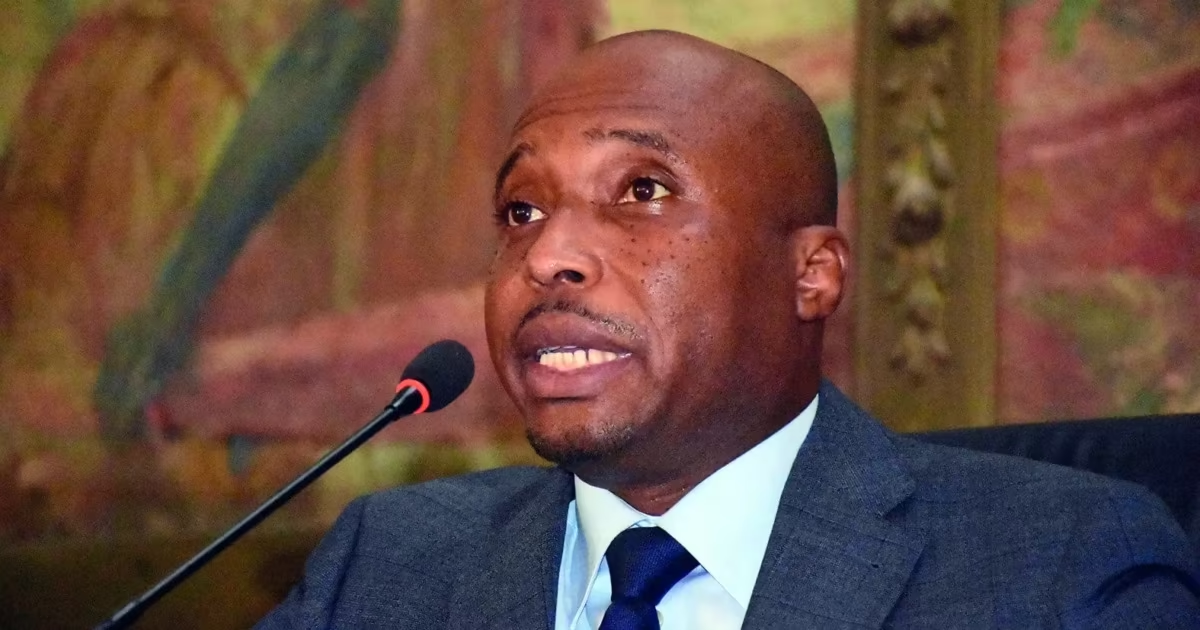
In Senegal’s political landscape, a striking contrast has emerged between those who dominate headlines and those who remain firmly rooted in the communities they aim to represent. While many opposition figures have retreated to Dakar’s corridors of power, only a handful of leaders continue to engage directly with citizens across the country.
Among these rare voices, Barthélémy Dias, former mayor of Dakar, and Maguette Sène, along with a small circle of allies, stand out for their relentless presence on the ground. Their approach contrasts sharply with that of other opposition figures, particularly those aligned with the Front pour la défense de la République et de la démocratie (FDR), who remain confined to Dakar, issuing statements and organizing meetings without tangible grassroots action.
Why ground-level engagement matters
Political analysts emphasize that true influence in Senegalese politics increasingly depends on how effectively leaders connect with the people. Alioune Badara Kandji, a sociologist specializing in social sciences, underscores this point: « The measure of political success is the ground itself. It is the only way to truly understand the needs of the population—and for the population to understand you. Direct interaction fosters trust and clarity, which no amount of rhetoric or media appearances can replace. »
Dias and Sène have taken this principle to heart. Their strategy revolves around sustained physical presence, listening sessions, and community outreach, rather than relying on distant debates or public sparring with rivals like Ousmane Sonko and Bassirou Diomaye Faye.
The Dias strategy: constant movement and dialogue
Since relaunching his Sénégal Bi Ñu Bokk movement in May 2025, Dias has transformed his approach into a nationwide campaign. Between international tours—including stops in the United States, Europe, and several African countries—and local visits, he ensures no corner of the country is left untouched. His recent initiative, Dokh Mbokk, embodies this philosophy: a commitment to proximity and direct dialogue with citizens.
His relentless pace reflects a clear vision: mass mobilization requires more than speeches—it demands presence. In the past month alone, he has crisscrossed Dakar’s neighborhoods, engaging residents in open conversations, placing membership cards, and listening to concerns firsthand.
Maguette Sène’s coalition: a new model of opposition
Maguette Sène has taken a different but equally bold path. As coordinator of And Liggéey Gox Yi – La Marche des Territoires, a coalition of over thirty organizations, he has made grassroots organization his top priority. Since being designated coordinator in August 2026, Sène has prioritized establishing local party cells across the nation, particularly in rural and underserved areas.
Dr. Macoumba Diouf, mayor of Latmingué and first vice-president of the coalition, highlights its mission: « Our focus is on standing by the people—helping them overcome their challenges and meet their legitimate aspirations. That is our job. We are not interested in internal rivalries or personal score-settling. »
Sène’s coalition represents a new wave in Senegalese opposition politics: one that values structure, depth, and long-term connection over short-term media battles.
Other voices in the field
While Dias and Sène lead with visible strategies, others like former Prime Minister Amadou Ba, Serigne Mboup, Mansour Faye, and Moustapha Diop also contribute through symbolic presence and selective public appearances. Though less vocal than their counterparts in the FDR, their occasional appearances on social and traditional media help maintain their visibility among supporters.
In a climate where many opposition figures remain mired in Dakar’s political games, these leaders are charting a different course—one built on proximity, persistence, and real connection with the Senegalese people.