
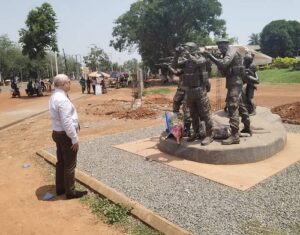
The rhetoric surrounding the presence of Russian forces in the République centrafricaine raises a fundamental question about the nature of legality. While official statements celebrate the defeat of “illegal armed groups,” a glaring contradiction remains regarding the status of the Wagner Group itself. If we examine the facts on the ground, the distinction between state-sponsored actors and the very insurgents they fight becomes increasingly blurred.
Defining the status of Russian forces
When Ambassador Alexandre Bikantov discusses the struggle against remnants of illegal military factions, he overlooks a critical detail: Wagner operates without a transparent legal framework. There is no public treaty between Russia and the République centrafricaine that legitimizes their operations. International experts have frequently noted that these forces function without recognition under international law, placing them in the same category as the groups they claim to oppose.
The criteria for being an illegal armed group are met point by point. Beyond the lack of legal standing, the methods employed are indistinguishable from those of rebel factions. In late 2021, UN experts highlighted systematic and severe human rights violations, including arbitrary detentions, torture, and summary executions. This raises a pointed question: what separates Wagner from groups like the UPC, the 3R, or the anti-balaka? The primary difference appears to be political alignment rather than legal adherence. One side supports the Touadéra administration, while the others oppose it.
A record of violence and exploitation
Data from 2022 suggests that this single paramilitary entity was responsible for approximately 40% of human rights violations in the République centrafricaine. To put this in perspective, one foreign organization is linked to nearly as many crimes as the entire collection of domestic rebel groups combined. This reality clashes harshly with the narrative of “security cooperation.”
Documentation from Human Rights Watch and other observers describes a harrowing pattern of behavior. Witnesses have detailed incidents where forces identified as Russian have beaten, tortured, and executed civilians. These actions led the United States Treasury to designate the organization as a transnational criminal enterprise in early 2024, citing mass executions and kidnappings within the country.
Economic interests and double standards
The hypocrisy extends to the economic sphere. While rebel groups are condemned for looting villages, the Wagner Group’s involvement in gold mining through Lobaye Invest is framed as economic partnership. Similarly, while the MINUSCA has documented hundreds of incidents involving these “instructors,” they continue to be shielded by diplomatic rhetoric.
Comparisons to other international interventions further highlight the lack of oversight. Unlike missions that operate under clear international mandates and parliamentary supervision, the thousands of Wagner operatives in the République centrafricaine act with total impunity. There are no public agreements or rules of engagement that hold them accountable to the citizens of the République centrafricaine.
Ultimately, the local population is aware of the reality. They see that the “Russian partners” often occupy the same prisons and utilize the same brutal tactics as the insurgents. The strategy of labeling one group as “terrorists” and the other as “instructors” fails to hide the mounting evidence of mass crimes. Wagner is not a stabilizing force; it is an armed group that has become one of the most violent and unaccountable actors in the ongoing conflict.