
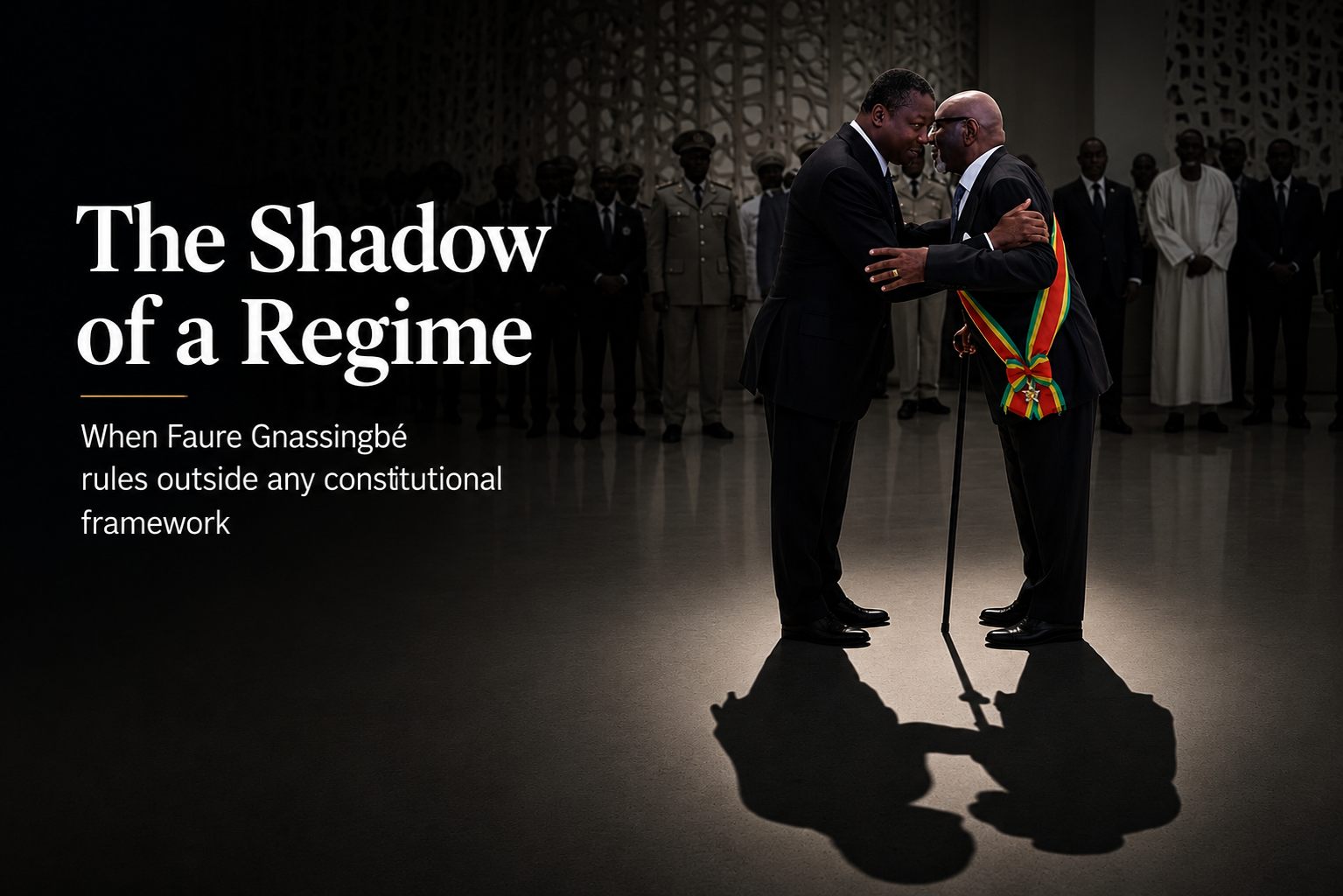
The recent detention of two French citizens in northern Togo has cast a harsh light on the deepening flaws in the country’s governance. Charged this week following several days in custody, their case appears to have been decided by a direct order from Faure Gnassingbé. According to reports, the president personally instructed his Justice Minister, Pacôme Adjourouvi, to ‘resist any external interference’ in their prosecution.
Yet this episode extends beyond diplomatic friction—it signals a profound erosion of institutional legitimacy. A pressing question now looms over Togo: who truly governs, and under what authority?
Institutional engineering to prolong a 20-year rule
Faure Gnassingbé’s presidency, now in its third decade, has taken a dramatic turn. Through a controversial constitutional overhaul in 2024, he reshaped Togo’s system from a presidential republic to a ‘parliamentary-style’ regime—without public consultation. The ceremonial president, Jean-Lucien Savi de Tové, now holds only symbolic powers, while the real executive authority rests with the newly created post of president of the Council, a position occupied by Gnassingbé himself since May 3, 2025.
This office has no term limits, a stark departure from the previous constitutional cap of two presidential terms. With 108 of the 113 parliamentary seats held by Gnassingbé’s Union pour la République (UNIR)—following opposition-boycotted elections—the outcome was predetermined. No longer a democratic rotation, this is a dynastic perpetuation in new institutional clothing.
Justice as a political instrument
The arrests of the two French journalists—Sébastien Perez Pezzani and Gaël Mocaër—while filming for a major television program, are not isolated. They reflect a pattern: intelligence services and the judiciary act on direct executive orders. The reported instruction to ‘resist any external pressure’ exposes a command chain that bypasses judicial independence entirely. When the head of state dictates legal outcomes to magistrates, the separation of powers becomes a fiction.
This instrumentalization of the law has been evident in other contexts: the suppression of June 2025 protests, the prosecution of dissenting voices, and the handling of sensitive cases. Law is no longer a framework of rights—it is a tool, mobilized or suppressed based on political convenience.
A legitimacy crisis rooted in silence
Who actually holds power in Togo? The answer is unequivocal: a leader who inherited office in 2005, consolidated it for two decades, and then rewrote institutions to retain control indefinitely. The 2024 constitutional reform was never put to a national referendum. Legislative elections were held amid boycotts and widespread protest. Even the Senate, a third of whose members are appointed by the Council president, reinforces executive dominance.
This is not a transition. It is the reassertion of personal rule under a thin veneer of institutional legitimacy. Titles change, procedures multiply, but the center of decision remains unchanged: Faure Gnassingbé, now president of the Council, commander-in-chief, and ultimate arbiter of the nation’s fate.
A system on the edge of rupture
When arbitrariness replaces law, when institutions become hollow shells, and when justice obeys political commands, the social contract frays. Togo is no longer facing a constitutional debate—it faces a regime that has chosen to govern outside any stable or predictable republican framework.
The question is no longer ‘who governs?’ It is now: how long can such a system persist before internal contradictions or popular pressure force a collapse?