
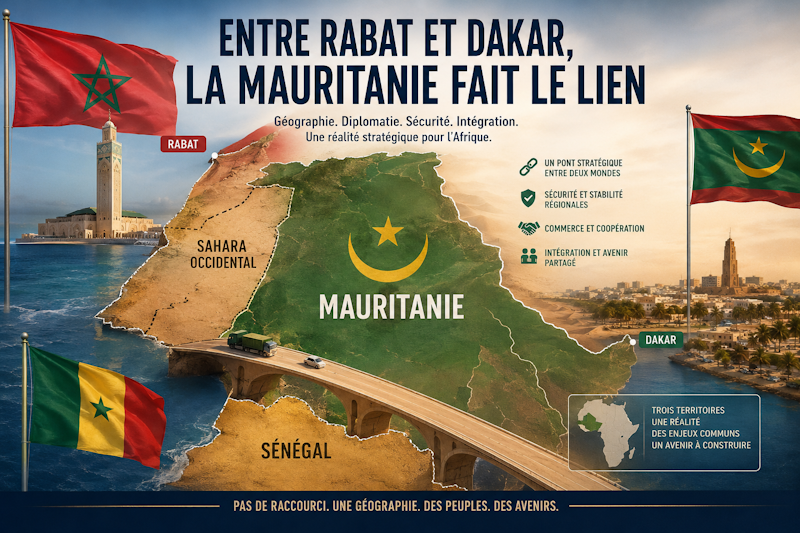

When analysts examine the ties between Morocco and Senegal, one critical factor often overlooked is the land in between: Western Sahara… and most notably, Mauritania. This observation comes from Mauritanian journalist Ahmed Ould Bettar, who highlights how geographical oversights can distort the understanding of regional dynamics.
The space separating Rabat from Dakar isn’t a straight line—it’s a complex web of geopolitical realities where Mauritania plays an indispensable role. While some may dismiss the country as merely a transit zone or desert expanse, its significance runs far deeper. Mauritania is a sovereign nation, a recognized diplomatic force, and a vital connector between North Africa and West Africa.
Its influence extends beyond borders, shaping security policies, economic exchanges, and regional integration. Ignoring its presence—or reducing it to a footnote—does more than simplify the narrative; it undermines the very foundations of stability in the Sahel and the Maghreb.
The Western Sahara, a territory mired in international dispute, lies at the heart of this discussion. Yet even here, Mauritania’s position cannot be overlooked. As a neighboring state, it navigates a delicate balance between maintaining relations with both Morocco and the Polisario Front, while asserting its own national interests. This balancing act is not merely symbolic—it has tangible consequences for trade, migration, and security across the Sahara.
Geopolitics cannot afford the luxury of shortcuts. Every border, every alliance, and every sovereignty carries weight. Mauritania is not a mere bystander in this equation; it is a central player whose decisions reverberate from Nouakchott to Nouadhibou and beyond.
For those who study or shape African diplomacy, the lesson is clear: geography is not just about maps—it’s about power, identity, and the enduring realities of a continent in motion.