
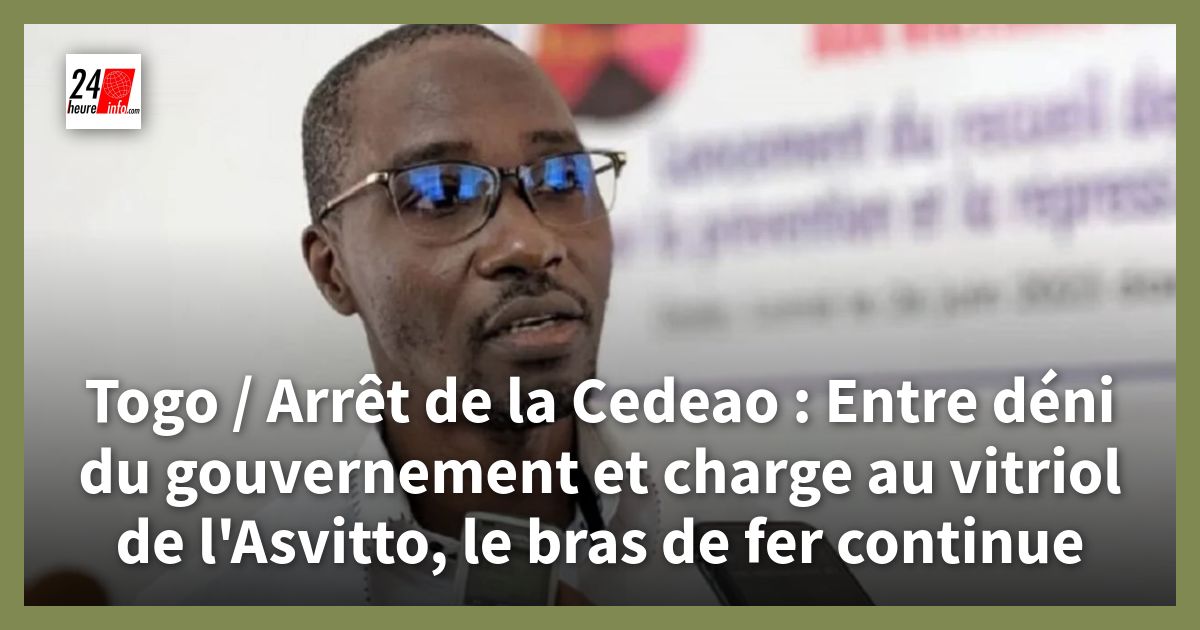
The Togo constitutional crisis continues to spark fierce debate in Lomé after the ECOWAS Court of Justice ruled against the government’s 2024 constitutional reforms. While authorities dismiss the ruling on technical grounds, civil society groups are escalating their condemnation, accusing the administration of state-backed illegality.
Lomé invokes legal technicalities to dismiss ECOWAS ruling
The Togolese government has responded to the regional court’s decision by arguing that the ECOWAS Court lacks jurisdiction to assess national constitutional matters. Officials claim the court holds « no authority to review domestic constitutional law or judge a sovereign nation’s constituent power, » effectively attempting to nullify the ruling’s legal weight within the country.
ASVITTO fires back: “State denialism at its worst”
The Association of Victims of Torture in Togo (ASVITTO) has launched a scathing public rebuttal, calling the government’s stance a « futile attempt to evade accountability. » In a statement, the group labeled the constitutional changes a « constitutional coup » and warned that its architects are « trapped in their own desperation, awaiting their inevitable downfall. »
ASVITTO condemned what it described as a « chronic pattern of disregard » for ECOWAS rulings, pointing to the continued detention of political prisoners in Lomé—despite multiple regional court orders demanding their immediate release. « Their refusal to comply is not just a legal failure; it is a moral one, » the association asserted.
« The Togolese government has long made a habit of ignoring binding regional judgments, treating them as mere suggestions rather than obligations. »
Civil society urges ECOWAS to enforce justice
Frustrated by the government’s defiance, ASVITTO has issued a direct appeal to ECOWAS, calling for « urgent measures to cure Togo’s institutional pathology » and enforce ECOWAS Court Judgment No. ECW/CCJ/JUD/01/26, delivered in January.
The landmark ruling declared Togo’s 2024 constitutional reform incompatible with the African Charter on Democracy, Elections, and Governance. ASVITTO’s message was unequivocal: « This form of state-backed lawlessness must end in our region. »
Political deadlock leaves prisoners in limbo
The standoff has devolved into a war of words, with the government clinging to legal technicalities while civil society demands accountability. Meanwhile, political detainees remain behind bars, their fate hanging in the balance as diplomatic and legal battles rage on. Their families continue to hope for justice—not just rhetoric—but a tangible resolution to their suffering.