
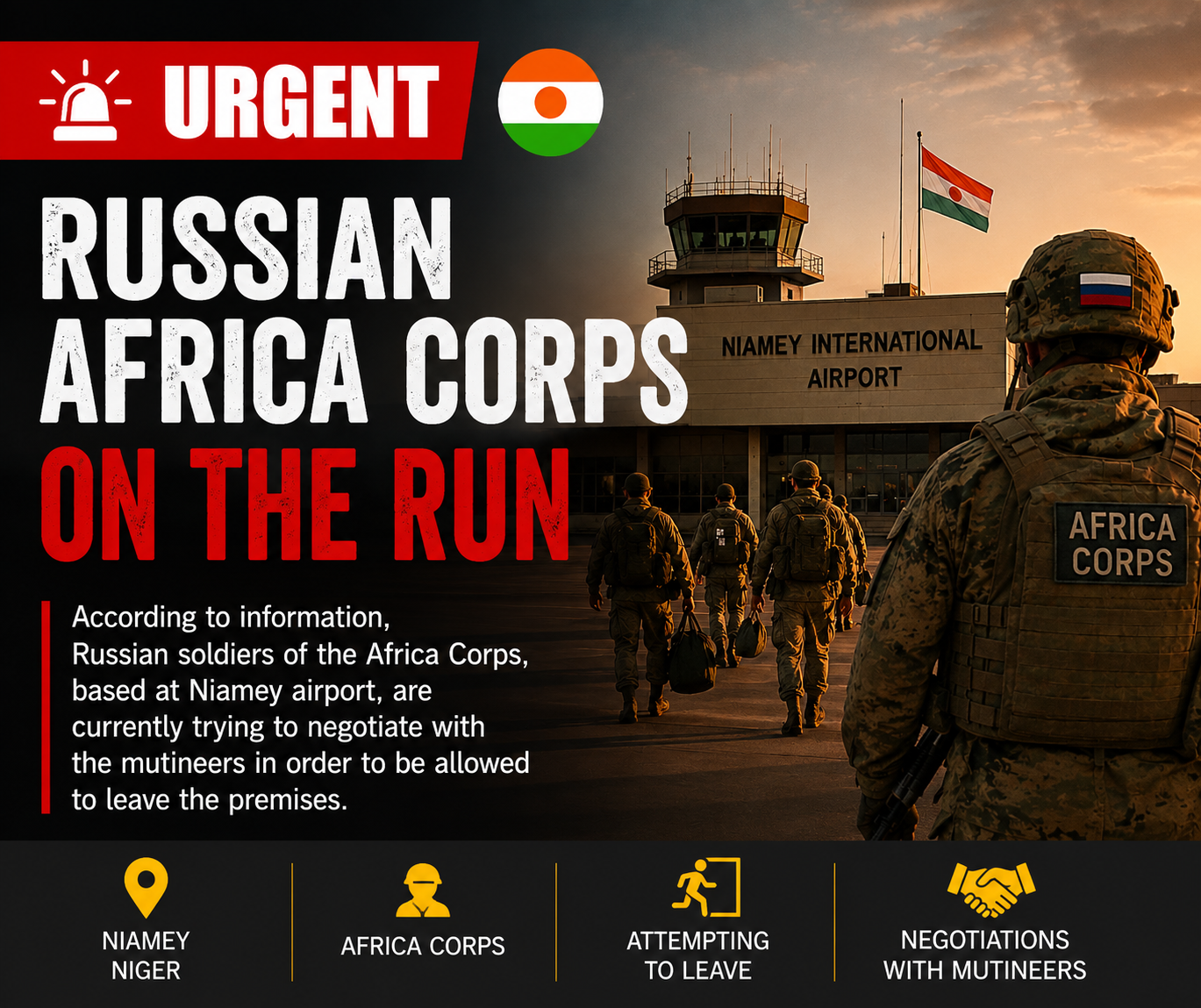
Recent gunfire and hostile movements near Niamey’s Diori-Hamani International Airport have cast a spotlight on a volatile situation: reports indicate that Russian personnel affiliated with the Africa Corps are urgently seeking to negotiate their evacuation with Nigerien military authorities controlling the site.
Should these reports hold true, the incident transcends a mere airport security breach. It underscores the precarious foundations of the security frameworks upon which several Sahelian military regimes have staked their stability.
When the ‘infallible partner’ falters
In a marked departure from traditional allies, multiple Sahelian juntas have pivoted toward Moscow, entrusting a portion of their security strategy to Russian forces. The Africa Corps, which has progressively assumed the role previously held by Wagner Group contingents in African theaters, has been touted as a solution to fortify regimes, safeguard leadership, and combat jihadist factions.
Yet the unfolding events in Niamey compel a critical assessment: what value does a security partnership retain when confronted with internal strife, mutiny, or a divergence between foreign interests and local authority?
Russian interests take precedence
Unlike national armed forces, foreign contingents operate under objectives aligned with their state’s geopolitical and strategic imperatives. This inherent mismatch creates a fundamental tension: a regime may view Russian support as vital to its survival, while Moscow may deem local conditions too perilous to risk further exposure of its personnel.
The reported negotiations in Niamey epitomize this contradiction. When risks escalate, self-preservation can swiftly eclipse commitments to allies.
The pitfall of security dependency
By over-relying on an external force, military regimes risk replacing one form of dependence with another. The promise of regained sovereignty—reduced reliance on Western powers and enhanced strategic autonomy—is undermined when critical assets such as airports, military bases, or logistical hubs are controlled by foreign troops.
The paradox is stark: seeking to escape one dependency may merely result in another. A sudden withdrawal of foreign forces can precipitate immediate security vacuums, destabilizing regimes already grappling with multifaceted crises.
Foreign fighters do not win wars
While foreign combatants or trainers may bolster operational capacities temporarily, they cannot address the root causes of insecurity. Effective counterinsurgency demands:
- Reliable intelligence networks;
- A competent and cohesive command structure;
- Well-trained and equipped national forces;
- Sustained state presence in rural areas;
- Community engagement and cooperation;
- Robust logistical support;
- And, above all, a coherent political strategy to dismantle insurgent recruitment networks.
No foreign force, regardless of its prowess, can permanently substitute for these essential components.
Measuring effectiveness remains elusive
The narrative of Russian involvement as a strategic breakthrough often obscures the need for tangible outcomes. When attacks persist, zones remain contested, and military losses mount, the fundamental question emerges: what tangible benefits justify the escalating costs of this partnership?
This divergence between political discourse and operational reality threatens to erode public and institutional confidence in the alliance.
Niamey: a military and political inflection point
The significance of the airport standoff extends beyond tactical concerns. It carries symbolic weight. Should Russian personnel—supposedly deployed to bolster the regime—find themselves negotiating their own departure with local forces, it exposes a rarely acknowledged truth: external powers do not control the internal power dynamics of the nations they operate within.
In essence, the presence of a foreign ally offers no guarantee of national cohesion, military loyalty, or political stability.
The illusion of invincibility unravels
Russia has cultivated an image of an unassailable, decisive military partner, capable of intervening where Western powers have faltered. This perception relies heavily on portrayals of strength, resolve, and efficiency.
However, a high-profile incident contradicting this narrative can shatter credibility. A force once presented as indispensable and formidable now negotiating its own withdrawal sends a powerful signal—one that adversaries may interpret as vulnerability, soldiers may question as uncertain support, and citizens may view as failed promises.
Strategic isolation looms
Regimes that have severed ties with Western and regional partners have progressively narrowed their diplomatic margins. If their primary military ally proves unwilling or unable to intervene decisively during a domestic crisis, they may face isolation—confronting security and political challenges alone.
The pertinent question shifts from ‘Who will fight the jihadists?’ to ‘Who will defend the regime in a moment of existential threat?’
Internal dissent and weakened deterrence
A military regime’s survival depends on the loyalty of its own armed forces. If foreign soldiers appear reluctant to confront crises or seek rapid evacuation, confidence in the regime’s stability may erode. In an environment fraught with internal tensions, mutinies, or factional rivalries, such perceptions can prove fatal.
The psychological impact—suggesting that power may be less secure than proclaimed—can accelerate instability and undermine deterrence.
The economic strain of foreign alliances
Military cooperation with foreign powers entails substantial financial costs for resource-constrained states. Yet, the efficacy of a security strategy cannot be measured solely by the number of foreign troops on the ground. True success lies in measurable outcomes: controlled territory, protected populations, prevented attacks, reduced military casualties, and the autonomous operational readiness of national forces.
When expenditures rise while insecurity persists, the model’s sustainability inevitably comes under scrutiny.
The path to sustainable defense
The Niamey incident serves as a reminder that real security is not forged through shifting alliances alone. It is built on institutional cohesion, professionalized armed forces, reliable intelligence, mutual trust between citizens and soldiers, and the state’s unchallenged authority across its territory.
External support can enhance these foundations but cannot replace them.
Is Niamey a warning?
Should the reports of negotiations surrounding the Africa Corps’ withdrawal be substantiated, Niamey may evolve from a localized security incident into a broader cautionary tale for Sahelian juntas that have anchored their survival strategies in foreign military partnerships.
An external power may supply weapons, trainers, fighters, and political backing—but it cannot guarantee regime stability, military unity, or victory over insurgency.
The deeper question confronting these juntas is stark: what unfolds when the supposedly indispensable partner prioritizes its own interests above all else?
Niamey may reveal a harsh truth: replacing one strategic dependency with another does not resolve the internal fragilities fueling the crisis.