
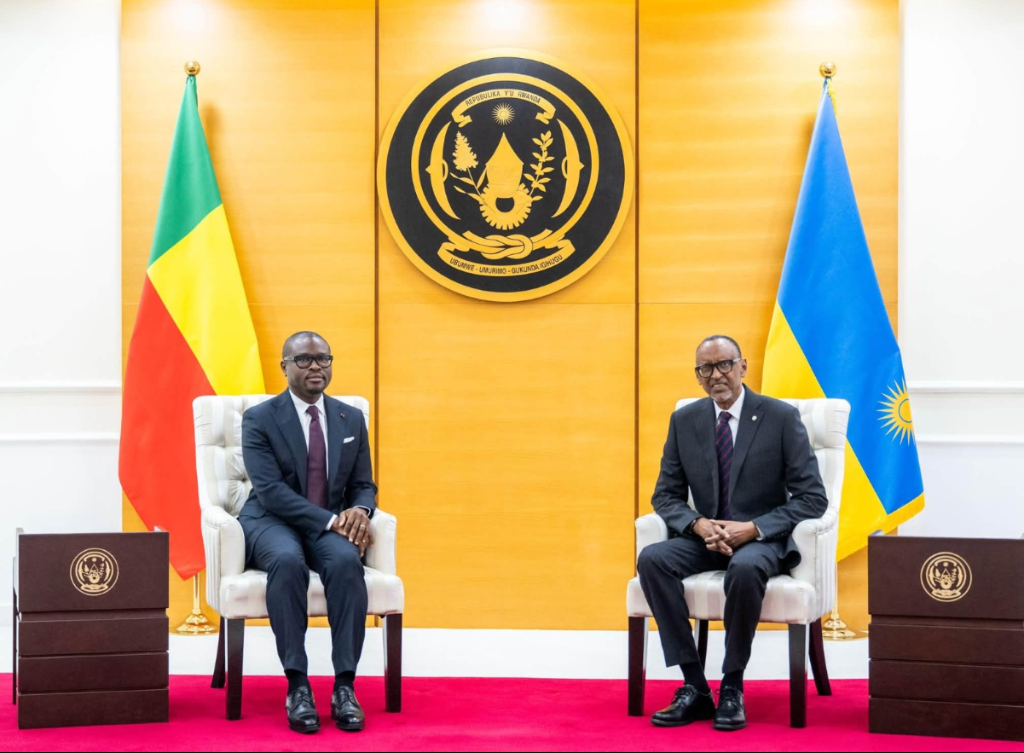
KIGALI — The two-day official visit of Benin’s president, Romuald Wadagni, to Rwanda has sparked widespread reaction and opened a fresh debate about where relations between Cotonou and Kigali go from here. His first diplomatic trip of this kind since taking office in May, the journey brought the Beninese head of state into the heart of the Rwandan capital, where President Paul Kagame received him. A moment of remembrance at the Kigali Genocide Memorial in Gisozi, honouring the victims of the 1994 genocide against the Tutsi, formed a central part of the programme.
A welcome in Kigali and the start of a wider conversation
On arrival in Kigali, Romuald Wadagni and the delegation accompanying him were greeted by crowds who turned out to acknowledge the new Beninese president’s first official visit to Rwanda. The head of state was then received at Urugwiro Village, the seat of the Rwandan presidency, by Paul Kagame.
That summit meeting stood out as the main highlight of the trip’s opening day. It comes as Cotonou and Kigali look to deepen their ties across several fields. The two countries already work within cooperation frameworks covering information and communication technologies, the modernisation of public services, urban planning, agriculture, and peace and security.
Why the stop at Gisozi is drawing so much attention
Beyond political and institutional exchanges, Romuald Wadagni’s trip carries a distinct memorial dimension. The Beninese president is expected at the Kigali Genocide Memorial in the Gisozi district, where the remains of more than 250,000 victims of the genocide against the Tutsi rest. The site serves at once as a place of remembrance, an education centre and a space for preserving memory.
The 1994 genocide claimed more than a million lives in roughly one hundred days, according to Rwandan authorities. Since then, the annual commemorations known as Kwibuka have held a central place in Rwanda’s national life, aiming to preserve the memory of the victims, pass the history on to new generations and draw lessons from the tragedy.
Gisozi occupies a special place in that framework. Inaugurated in 2004, it houses exhibitions devoted to the genocide, archives, survivors’ testimonies and a space dedicated to child victims. It is also the burial site of hundreds of thousands of people.
For the Beninese president, the expected tribute at Gisozi fits within the protocol of high-level official visits to Rwanda, while giving this diplomatic trip a human dimension that has resonated with observers.
Kagame and Wadagni: a meeting that extends an ongoing dialogue
The encounter between Paul Kagame and Romuald Wadagni comes a few months after the Beninese president’s inauguration. Rwanda was represented at that ceremony by its prime minister, Justin Nsengiyumva — a gesture that Rwandan authorities presented as a sign of the importance attached to relations between the two countries. Kigali stressed at the time the growing strength of the ties between Rwanda and Benin.
The visit therefore allows the two leaders to build on a dialogue already under way at the institutional level. Discussions are expected to focus on ways of strengthening bilateral cooperation and encouraging new partnerships.
The wider African context could also give the exchanges broader significance. Rwanda and Benin are each, in their own way, pursuing policies of economic transformation, administrative modernisation and infrastructure development. Kigali in particular highlights investment, entrepreneurship and digital technologies among the pillars of its development policy.
Memory and cooperation: the dual message of the trip
Placing the Gisozi Memorial on the visit’s agenda gives the trip a particular tone. In contemporary Rwanda, memorial sites are not solely devoted to remembering the victims: they also contribute to the work of transmitting history and raising awareness of the consequences of discrimination and mass violence.
The Gisozi site preserves testimonies, documents and archives linked to the genocide. The Genocide Archive of Rwanda, housed within the memorial, brings together material from survivors and partner organisations, among others.
For Kigali, the memory of the genocide remains closely tied to the notions of national unity, reconciliation and the prevention of mass violence. For foreign visitors, a stop at Gisozi traditionally represents a solemn moment, marked by quiet reflection before the tombs and by the testimonies kept at the site.
Romuald Wadagni’s visit therefore sits at the crossroads of two dimensions: the strengthening of relations between Benin and Rwanda, and recognition of the memory of a tragedy that continues to leave a deep mark on Rwandan society.
Reactions and what to expect next
The visit has prompted debate in both countries about the direction of the relationship. Some see the Gisozi stop as a deliberate signal that Cotonou intends to anchor its diplomacy in shared values of remembrance and reconciliation. Others are watching more closely for concrete outcomes in trade, technology and security cooperation.
After a first day given over in particular to the official welcome and talks with Paul Kagame, the rest of the stay is expected to let the Beninese president continue his discussions with Rwandan authorities. The two-day visit is thus set to lay the groundwork for a new phase in relations between Cotonou and Kigali, with a stated determination to consolidate political ties and cooperation between the two states.