
A month-long Benin showcase prompts debate about memory, restitution and the future of cultural exchange
When Fnac Saint-Lazare in Paris announced it would dedicate nearly a month to Benin, from 22 September to 17 October 2026, the immediate response was curiosity. Then came the questions. By the time the final showcase wraps, the conversation will have moved well beyond the store’s third-floor forum where most events are held.
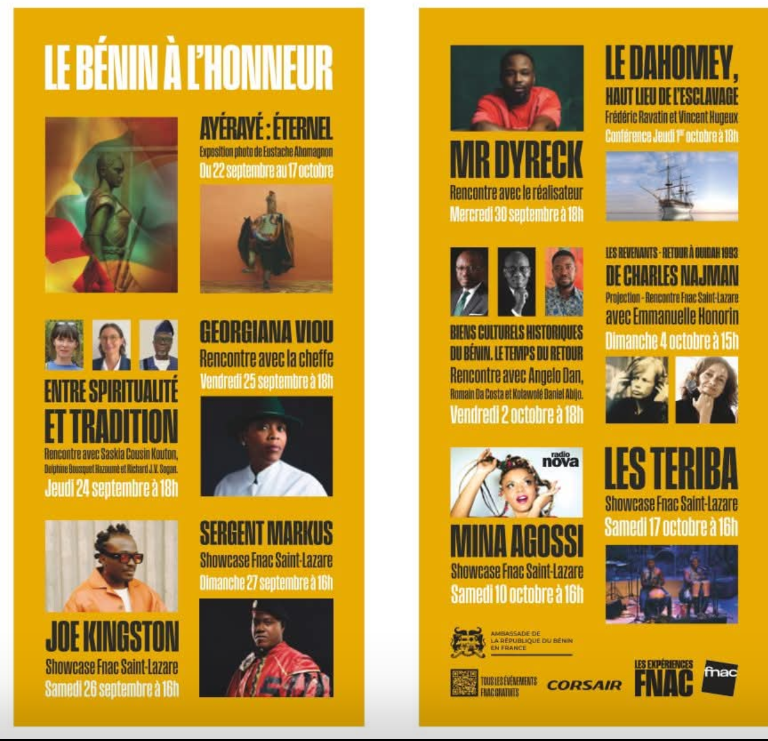
The lineup is dense: photography, panel discussions, film, slam, jazz and gastronomy. Several events are organized with support from the Embassy of the Republic of Benin in France. But the real story is not the calendar. It is what this program sets in motion — and what it leaves unresolved.
An opening image that frames the whole debate
The first event, on 22 September, is a photography exhibition titled “Ayérayé: Éternel,” featuring the work of Beninese photographer and designer Eustache Ahomagnon. Running through 17 October, it sits at the intersection of photography and textile creation.
Ahomagnon’s images explore memory, spirituality and contemporary creation through the world of Egungun, figures tied to ancestor worship among the Yoruba. The photographs are paired with textiles inspired by the shapes, materials and movements associated with those traditions. From the outset, the exhibition signals that this is not a folkloric display but a confrontation with living heritage.
Spirituality, authorship and the question of transmission
On 24 September, sociologist and author Saskia Cousin Kouton, journalist Delphine Bousquet Hazoumè and researcher Richard J.V. Sogan gather for a conversation on spirituality, traditions and books dedicated to Beninese heritage. The following day, chef Georgiana Viou takes the stage to discuss her journey and her book “Oui cheffe! Du Bénin à l’étoile Michelin.” Her career raises a broader point: gastronomy as a vehicle for cultural transmission, with Beninese ingredients and flavors threaded through a cuisine shaped by multiple influences.
Music follows. On 26 September, Joe Kingston delivers a showcase built around “Afro futur vibes,” blending hip-hop with contemporary African sounds. On 27 September, poet and slam artist Sergent Markus presents “Vodun Gospel,” an album steeped in musical references drawn from vodun culture.
Dahomey, slavery and restitution: the most sensitive pages
The program does not avoid difficult history. On 1 October, a discussion focuses on Dahomey and the history of slavery. Writer and journalist Vincent Hugeux speaks with Frédéric Ravatin, an engineer and scientific scenographer, about the “Bateau de la Mémoire” in Ouidah — a memorial installation dedicated to the transatlantic slave trade.
The next day, restitution of cultural property between France and Benin takes center stage. Ambassador Angelo Dan, Romain Da Costa and heritage curator Kolawodé Daniel Abidjo revisit a historical process that has deeply marked cultural relations between the two countries. These choices give the event a strong memorial dimension. It is no longer simply about presenting works or artists; it is about asking how a nation narrates its past, preserves its heritage and positions itself in the world.
Film as a bridge between past and present
On 4 October, cinema takes over with a screening of “Retour à Ouidah 1993. Les Revenants,” a documentary by Charles Najman about the return to Ouidah — a city bound up with the history of vodun and of the African diaspora created by the slave trade. A conversation with journalist, producer and programmer Emmanuelle Honorin follows.
Made in the context of the Ouidah 92 Festival, the film invites viewers to set images of the past against contemporary questions about memory, identity and the ties between Benin and its diaspora.
A contemporary scene that refuses to be sidelined
Current creation is not an afterthought. On 30 September, filmmaker, co-producer and cinematographer Mr DYRECK receives a carte blanche. His work, produced between Benin and France, reflects a new generation using images to tell West Africa’s stories differently.
On 10 October, jazz singer Mina Agossi presents her album “Dynamic. Tribute to Dinah Washington,” adding another layer to the musical program. The closing event on 17 October features Teriba, described as Benin’s first all-female music group. Founded in 2002, the collective is known for a cappella singing and for its commitment to promoting Beninese cultural heritage.
Paris as a crossroads — and what happens after
Over nearly four weeks, Fnac Saint-Lazare turns its Parisian space into a showcase for Benin. From photography to gastronomy, slam to jazz, cinema to history, the program paints a plural portrait of a country whose heritage keeps feeding contemporary creation. It also makes clear that Beninese culture is not a frozen legacy. It is transmitted, reinvented and debated.
Between vodun traditions, the memory of Dahomey, the history of the slave trade, debates on restitution and new artistic expressions, a whole narrative of Benin takes over the heart of Paris. All announced events are free, subject to availability. The store invites the curious, African culture enthusiasts, members of the Beninese diaspora and anyone eager to discover or rediscover a country whose history and creativity occupy a singular place in cultural exchanges between Africa and France.
But the reactions now forming around this program point to something larger. The debates on restitution and memory will not end when the exhibition comes down. The question is whether this month in Paris becomes a template for deeper exchange — or remains a one-off moment that fades once the lights go out.