
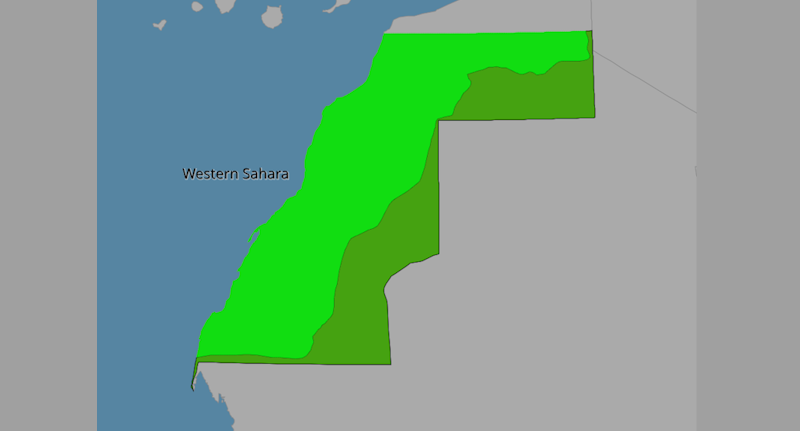

Western Sahara remains the final unresolved decolonization issue on the African continent. This territory, officially recognized by the UN as non-self-governing, has become a focal point where international law, regional power struggles, and energy security intersect.
There is a striking disparity between the static military situation and the rapidly evolving international diplomatic landscape. While the front lines remain unchanged, the political maneuvering behind the scenes has reached a fever pitch.
1. Military stagnation versus diplomatic momentum
Since the 1991 ceasefire brokered by the UN between Morocco and the Polisario Front, troop positions have remained largely fixed. Morocco maintains administrative, economic, and military control over the vast majority of the region. Conversely, the Polisario Front oversees a sparsely populated desert strip east of the “Berm,” the fortified sand wall constructed by Morocco.
However, this lack of movement on the ground is countered by high-stakes global geopolitics. The conflict is now deeply embedded in international calculations regarding migration management, the security of energy supplies, and the evolving alliances of major world powers.
2. The impact of UN Resolution 2797
The landscape shifted significantly with the adoption of Resolution 2797 by the UN Security Council on October 31, 2025. This decision highlighted several key trends in the current era:
- A lack of consensus: While the resolution passed, China, Russia, and Pakistan chose to abstain. Algérie, a longtime supporter of the Polisario Front, refused to participate in the vote to signal its disapproval.
- Support for Morocco’s position: The resolution extended the MINURSO mission until October 2026 and reaffirmed that future negotiations should be based on the autonomy proposal submitted by Morocco.
- Strategic ambiguity: Although the UN does not formally recognize Moroccan sovereignty and maintains the principle of self-determination, by framing the Moroccan autonomy plan as the primary starting point, it effectively marginalizes other options, such as full independence.
In Rabat, the passage of this resolution was viewed as a major diplomatic triumph, reinforcing the belief that international momentum is now moving decisively in favor of Morocco.
3. Historical roots of the deadlock
To grasp the current impasse, it is essential to look back at the history of this territory, which was first colonized by Spain in 1884:
ICJ Advisory Opinion (1975)
When the case was brought before the International Court of Justice, the court ruled that while historical ties of allegiance existed between certain Sahrawi tribes and the Sultan of Morocco, these did not constitute territorial sovereignty or negate the population’s right to self-determination.
The Green March and the Madrid Accords (November 1975)
Morocco initiated the Green March, leading hundreds of thousands of civilians across the border. Shortly after, Spain signed the Madrid Accords, transferring its administrative responsibilities and sharing control between Morocco and Mauritanie, though this was done without UN approval.
Mauritanie’s withdrawal and the military stalemate (1979 – 1989)
Facing economic collapse and political instability, Mauritanie abandoned its claims in 1979. Morocco moved to fill the power vacuum. As the Polisario Front—which had declared the SADR—launched attacks, Morocco built the “Berm,” resulting in a military stalemate by the late 1980s.
Deployment of MINURSO (1991)
A ceasefire was established, and MINURSO was deployed to oversee peace and prepare for a referendum on self-determination. However, this vote never occurred due to fundamental disagreements over voter eligibility and the census of the Sahrawi population.
Conclusion: The dominance of political realism
Current analysis suggests that the persistence of this status quo is driven more by political realism than by legal frameworks. Global powers and regional leaders are prioritizing geopolitical stability, predictability, and the preservation of strategic alliances.
Western Sahara remains in a complex state of suspension. While a final resolution is theoretically possible, it remains politically challenging for the international community to implement in the current global climate.
#Saharaoccidental #polisario #Maroc #50ansdeconflit #géopolitique #diplomatie #guerre #ONU #MINURSO #MarocSahara #MarocPolisario #Algérie