
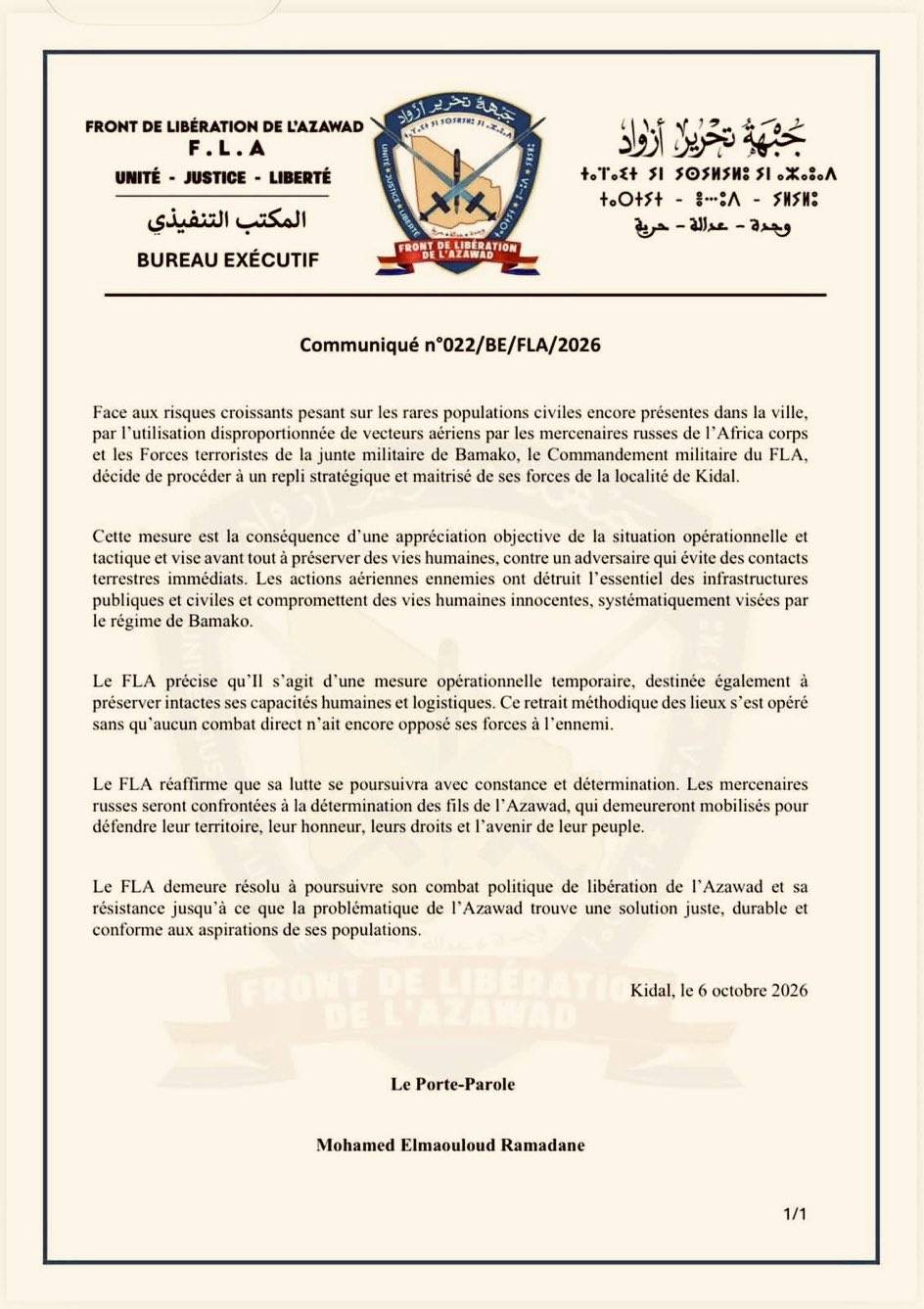
The sudden withdrawal of the Azawad Liberation Front (FLA) from Kidal has sent shockwaves through northern Mali, prompting urgent questions about the strategic logic behind the move. Military analysts are now debating whether this represents a calculated tactical retreat or the first domino in a larger shift in the decade-long war for the Azawad region. The FLA leadership insists this is a temporary « mastered withdrawal » to avoid direct confrontation with government forces, but observers note that such maneuvers have historically preceded even more intense phases of the conflict.
Why Kidal remains the battleground of Mali’s existential struggle
Kidal isn’t just another city in northern Mali—it is the symbolic heart of the Tuareg independence movement and a perpetual flashpoint in the nation’s fractured history. For Bamako, controlling Kidal is essential to asserting territorial sovereignty and projecting central authority across the vast Sahel belt. For the FLA, it represents the centerpiece of their claim to the Azawad homeland, a territory stretching across northern Mali that they have fought to defend since the 1960s. The city has been lost, regained, and lost again in cycles of violence that show no signs of ending.
The shifting sands of power: From Russian withdrawal to FLA resurgence
Kidal fell under Malian government control in late 2023, thanks to a joint offensive with Russian-backed Wagner forces—then operational in Mali under the name Africa Corps. At the time, the FLA claimed it had withdrawn from the city to avoid heavy casualties, warning that outright confrontation would only lead to unnecessary loss of life. But by April 2026, the FLA reversed the table by launching a coordinated offensive that reclaimed Kidal and forced the Africa Corps units to evacuate toward Tessalit, with reports of over 400 Russian paramilitaries being extracted under heavy escort. Now, less than two years later, the roles have reversed once more.
Is the FLA’s withdrawal a sign of retreat or rearmament?
The FLA’s language—calling this a « strategic and controlled withdrawal »—recalls tactics used in earlier phases of the conflict. In military terms, a strategic retreat is not defeat—it is a shift in position designed to conserve resources and regroup for future battles. The Sahara’s vast desert terrain offers an ideal environment for such maneuvers: swift movement, dispersed units, and intimate knowledge of the land allow armed groups to vanish and reappear without warning. But the question remains: Is this merely a pause, or is it the calm before another storm?
History suggests the latter. The last time Kidal was the center of military tension, in 2014, a Malian offensive ended in disaster for government troops. A 2014 battle near Kidal left dozens of Malian soldiers dead and forced Bamako to renegotiate its campaign. The scars of that defeat still linger in military records—and in the minds of policymakers.
Tinzaouatène 2024: The moment Wagner’s myth of invincibility shattered
No single event illustrates the fragility of outside military power in northern Mali more than the July 2024 battle at Tinzaouatène. A combined column of Malian troops and Russian Wagner (Africa Corps) fighters was ambushed by Tuareg armed groups in the middle of a sandstorm. The engagement led to catastrophic losses: the CSP—a coalition that includes the FLA—claimed to have killed 84 Wagner fighters and 47 Malian soldiers. Though these figures were never independently confirmed, the damage to the Wagner brand was irreversible. The withdrawal from Kidal in 2026 only reinforced perceptions that Moscow’s influence in the Sahel was waning, not waxing.
What many analysts missed, however, was that this setback did not end the conflict—it intensified it. Government forces retook control of Anéfis in July 2026 after a bloody week-long battle, proving that losses for Russian-aligned units are quickly followed by counteroffensives. The cycle continues.
Bamako’s dilemma: Can military victory be translated into political control?
For Mali’s transitional government, every loss of territory is a political liability. Kidal’s symbolic weight is unmatched: it is the birthplace of modern Tuareg nationalism and a recurring reminder of Bamako’s inability to fully integrate the north. If the FLA’s withdrawal is confirmed as temporary, it may signal not a weakening of the rebellion, but a recalibration of strategy—one aimed at preserving fighters while preparing for a future blow. In a conflict where « strategic retreats » have repeatedly led to larger offensives, the pullback from Kidal could mark not the end of the battle, but the next phase of war.
What’s next: Will the FLA regroup or launch a new offensive?
The coming weeks will reveal whether the FLA’s withdrawal is a defensive repositioning or the prelude to a new assault. The group’s history shows a pattern: retreat, regroup, return. If the FLA chooses to consolidate in other strongholds—perhaps near the Algerian border, where supply lines are harder to disrupt—it may avoid direct engagement while preparing for another strike. Alternatively, if it seeks to exploit the vacuum created by the Africa Corps’ departure, Kidal could become the springboard for a bolder campaign.
One thing is certain: In the Azawad, a withdrawal rarely means surrender. It is, at best, a pause before the next wave of violence. And in northern Mali, every pause is temporary—and every resumption of fighting is inevitable.
The geopolitical stakes: Beyond Mali, a regional power shift
The FLA’s actions are not isolated. They reflect broader regional dynamics, from shifting alliances in the Sahel to the declining influence of foreign military actors. As the Russia-backed Africa Corps struggles to maintain its foothold, other armed groups—including those with ties to Algeria or local militias—are repositioning themselves in anticipation of a power vacuum. If the FLA’s withdrawal from Kidal opens the door to a new balance of power, the consequences will ripple far beyond Mali’s borders, reshaping the security architecture of the entire Sahara-Sahel region.
In this context, the question is no longer whether Kidal will fall again—but how soon, and at what cost. The FLA’s retreat may appear tactical, but in the unforgiving terrain of the Azawad, strategic withdrawals have a way of becoming historical turning points.