
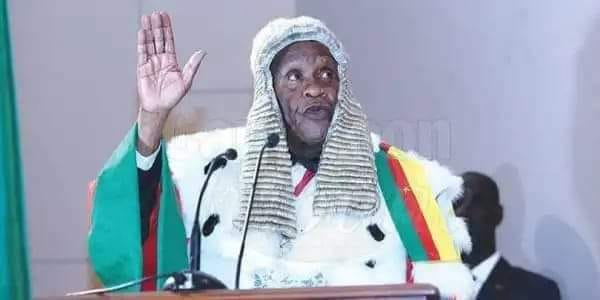
The man behind the council: Clément Atangana’s career and rise to power
Clément Atangana, the former president of Cameroon’s Constitutional Council, passed away in Paris on October 4, 2026, after a prolonged illness. Born on December 20, 1941, in Ekoumeyeck, a town in the Nyong et So’o region, his name became synonymous with the highest judicial body in Cameroon—a role he accepted just months before the 2018 presidential election. His tenure, spanning eight years, left an indelible mark on the country’s electoral landscape, shaping how contests are resolved and disputes adjudicated.
Atangana’s tenure at the Constitutional Council was marked by decisive rulings that echoed through Cameroon’s political landscape. His steady voice, often delivering the word ‘irrecevable’—meaning inadmissible—became a defining feature of electoral challenges, particularly those raised by opposition figures. Whether in contentious presidential elections in 2018 or 2025, his decisions reinforced the council’s role as the ultimate arbiter, though they also fueled debates about the institution’s independence and alignment with the ruling establishment.
From the courts to the constitutional council: a career built on legal challenges
Atangana’s journey in the Cameroonian judiciary spanned decades, reflecting a career built on expertise, loyalty to the state, and an intricate understanding of legal systems. He began his magistracy in 1968 after training at the École Nationale d’Administration et de Magistrature (ENAM) and the Institut International d’Administration Publique in Paris. His early roles included positions as an investigating judge in Nkongsamba, president of various tribunals across regions like Eséka, Bafia, and Sangmélima, as well as prosecutor general in Maroua and president of the Court of Appeal in the Centre region.
Before ascending to the Constitutional Council, he served as a counselor at the Supreme Court and president of its Administrative Chamber, a position from which he retired in 2014. Four years later, at a time when the government sought stability in its judicial institutions ahead of critical elections, he was appointed to lead the Constitutional Council—a role that cemented his legacy as both a pillar of the judiciary and a polarizing figure in Cameroon’s political narrative.
The council under Atangana: rulings, reactions, and rising skepticism
During his tenure, the Constitutional Council handled two high-stakes presidential elections—2018 and 2025—both of which were followed by legal challenges from defeated opposition candidates. In 2018, Maurice Kamto of the Movement for the Rebirth of Cameroon (MRC) and his supporters contested the results. In 2025, it was Issa Tchiroma Bakary who raised objections. Despite these challenges, the council never upheld a single opposition appeal during Atangana’s leadership—a fact that drew criticism from those who viewed the institution as an extension of the executive rather than an impartial arbiter.
In a widely shared video from October 2025, Atangana was seen congratulating supporters after the proclamation of results, stating, “I am happy that you are celebrating your candidate’s victory and the work carried out by your father.” The remark, though likely intended as a gesture of official closure, fueled perceptions that the council operated under influence or at least with a disregard for opposition claims—a narrative that persisted throughout Atangana’s tenure.
What comes next? The constitutional council’s leadership vacuum and implications for Cameroon
With Atangana’s death, the Constitutional Council is now without its founding president, leaving a void at the helm of Cameroon’s highest electoral oversight body. The president of the republic holds the authority to appoint his successor through a presidential decree, a process that will be closely watched by political observers, opposition parties, and civil society groups. The moment represents more than a routine transition—it is a critical juncture for an institution already under scrutiny for its perceived lack of autonomy.
The council’s future leadership will face immense pressure to restore or redefine its credibility. Will the next president be seen as an independent figure, capable of adjudicating disputes without prejudice? Or will the appointment further entrench perceptions that the judiciary remains intertwined with the political elite? These questions are no longer theoretical; they now define the immediate future of Cameroon’s constitutional framework and its democratic processes.
Echoes of change: how Atangana’s departure reshapes Cameroon’s judicial landscape
The passing of a figure like Clément Atangana does more than mark the end of an era—it exposes the fragility of institutions tasked with safeguarding the rule of law in a polarized society. His death has ignited conversations about the structural independence of the Constitutional Council and the broader judiciary in Cameroon. While his legacy includes decades of service and a commitment to legal rigor, it is also defined by the controversies that surrounded his rulings and the council’s role in contentious elections.
As Cameroon prepares for a new chapter under a yet-to-be-named leader, the spotlight will remain on the council’s ability to navigate disputes with transparency and impartiality. The appointment of his successor will not only fill a leadership gap but could also signal whether the institution is poised for reform or destined to carry forward the controversies of the past. In a nation where trust in electoral institutions remains fragile, Atangana’s absence leaves behind a void that demands more than a mere ceremonial replacement—it demands a fundamental reassessment of justice, trust, and the balance of power in Cameroon.