
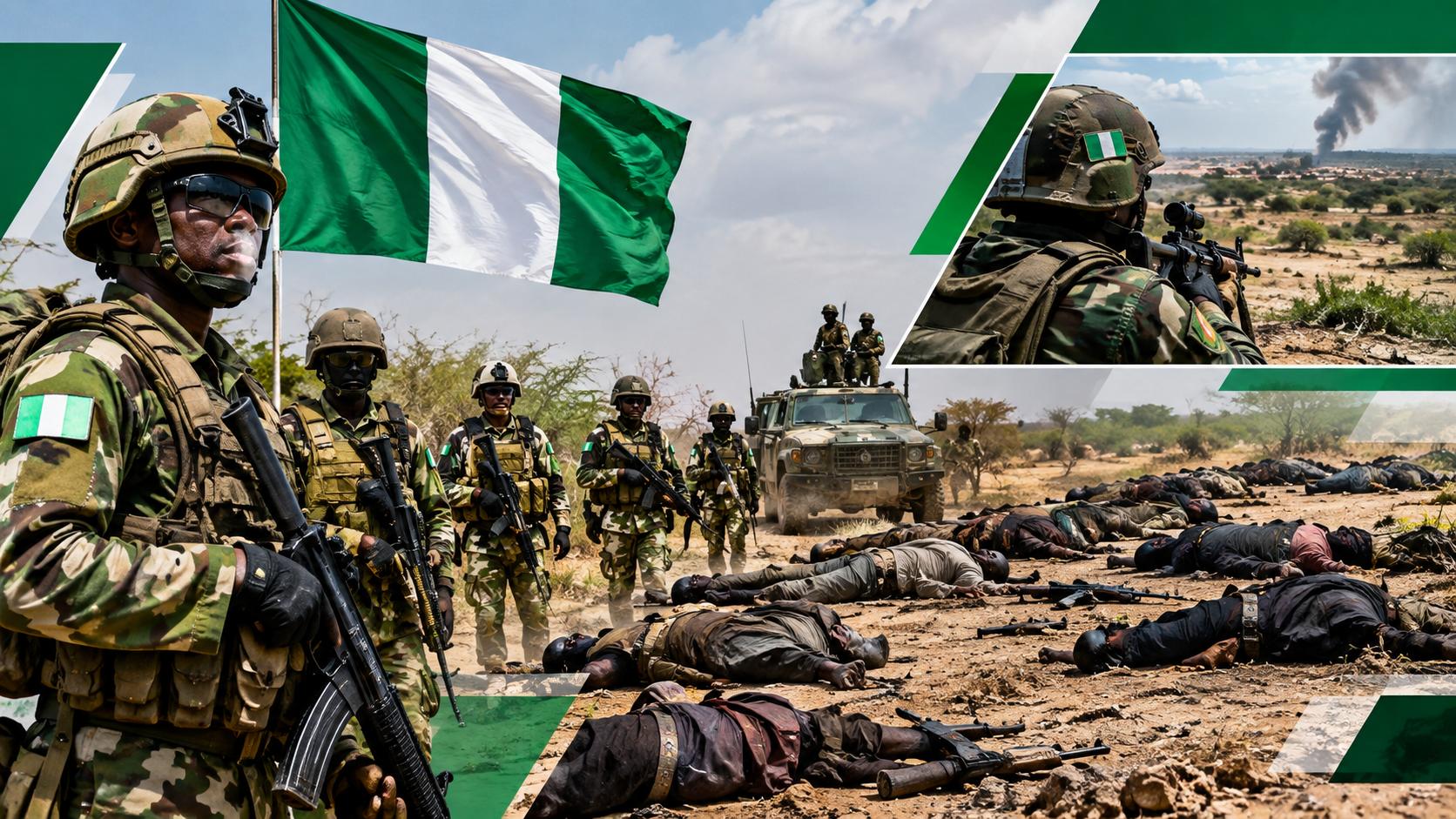
The Nigerian military’s latest offensive against Boko Haram and ISWAP factions in the Lake Chad Basin has sparked intense public debate, with officials unveiling staggering casualty figures and a wave of civilian rescues that are reshaping the narrative of a nearly fifteen-year insurgency. As the handover ceremony of Joint Task Force HADIN KAI took place in Maiduguri, outgoing commander Major General Abdulsalam Abubakar presented a detailed breakdown of operations conducted since April 2025, revealing not just military victories but also profound humanitarian consequences.
Era of intensified military pressure on jihadist networks
The numbers tell a story of unprecedented pressure on insurgent groups operating in the volatile region. Over 1,100 jihadist fighters have been neutralized through targeted ground and aerial operations across critical zones like the Sambisa Forest, Mandara Mountains, and the Lake Chad periphery. This figure represents one of the highest combatant death tolls recorded in a single operational cycle, signaling a significant shift in battlefield dynamics.
The military’s campaign has also dismantled key logistical hubs, seizing 475 firearms of varying calibers — from standard assault rifles to heavy weaponry — along with substantial ammunition reserves. Perhaps most critically, 295 improvised explosive devices (IEDs) were disarmed, neutralizing a persistent threat that had long hampered troop movements and civilian safety in the region.
Logistics disruption and surrenders: The domino effect of military pressure
Beyond direct combat, intelligence-led operations targeted the financial and supply networks sustaining insurgent operations. A total of 758 suspected collaborators and logisticians were apprehended, cutting off vital lifelines in food, fuel, and communication equipment that had enabled jihadist factions to maintain their operations. This strategic blow has been compounded by a surge in defections, with 969 individuals — including active fighters and their families — surrendering under the government’s Disarmament, Demobilization, and Reintegration (DDR) program.
The DDR initiative has become a cornerstone of the military’s strategy, offering a pathway out of violence for those disillusioned by the prolonged conflict. The surge in surrenders reflects both the effectiveness of sustained military pressure and the growing fractures within insurgent ranks.
638 Civilians rescued: A humanitarian breakthrough amid ongoing tragedy
One of the most poignant outcomes of recent operations has been the liberation of 638 civilians, predominantly women and children, who had been held captive in militant-controlled training camps. These rescues followed meticulous military operations targeting known jihadist strongholds, offering a rare moment of relief in a region plagued by abductions and forced conscription.
Each rescued civilian undergoes rigorous medical and psychological evaluations before being transitioned to civilian authorities and humanitarian organizations for long-term rehabilitation. These efforts underscore the dual nature of the military’s mandate: not only to defeat insurgents but also to restore dignity and security to affected communities.
Why the fight against jihadism in Nigeria remains a work in progress
Despite these tactical victories, the broader security landscape remains precarious. The insurgency, which erupted in 2009, has left over 40,000 dead and displaced more than two million people across the Lake Chad Basin. While the recent military surge has weakened Boko Haram and ISWAP significantly, their remnants continue to exploit gaps in security, launching ambushes and deploying IEDs to destabilize freed areas.
The handover of command within HADIN KAI marks a pivotal moment. The incoming leadership faces the dual challenge of consolidating recent gains while addressing the underlying grievances that fuel insurgency — poverty, lack of education, and weak governance in the region’s most vulnerable communities.
Sustaining progress: The road ahead for military and civilian authorities
For lasting peace to take root, military victories must be complemented by robust governance, economic development, and community engagement. The DDR program’s success will depend on its ability to reintegrate former insurgents and rescued civilians into society, offering alternatives to a life of violence. Meanwhile, security forces must remain vigilant, adapting to the evolving tactics of splintered jihadist factions that continue to operate in remote and ungoverned spaces.
The public debate now centers on whether these recent gains represent a turning point or merely a temporary respite in a decades-long conflict. Whatever the outcome, the military’s latest operations have undeniably altered the balance of power, forcing both insurgents and civilian communities to reassess their positions in a rapidly evolving security landscape.