
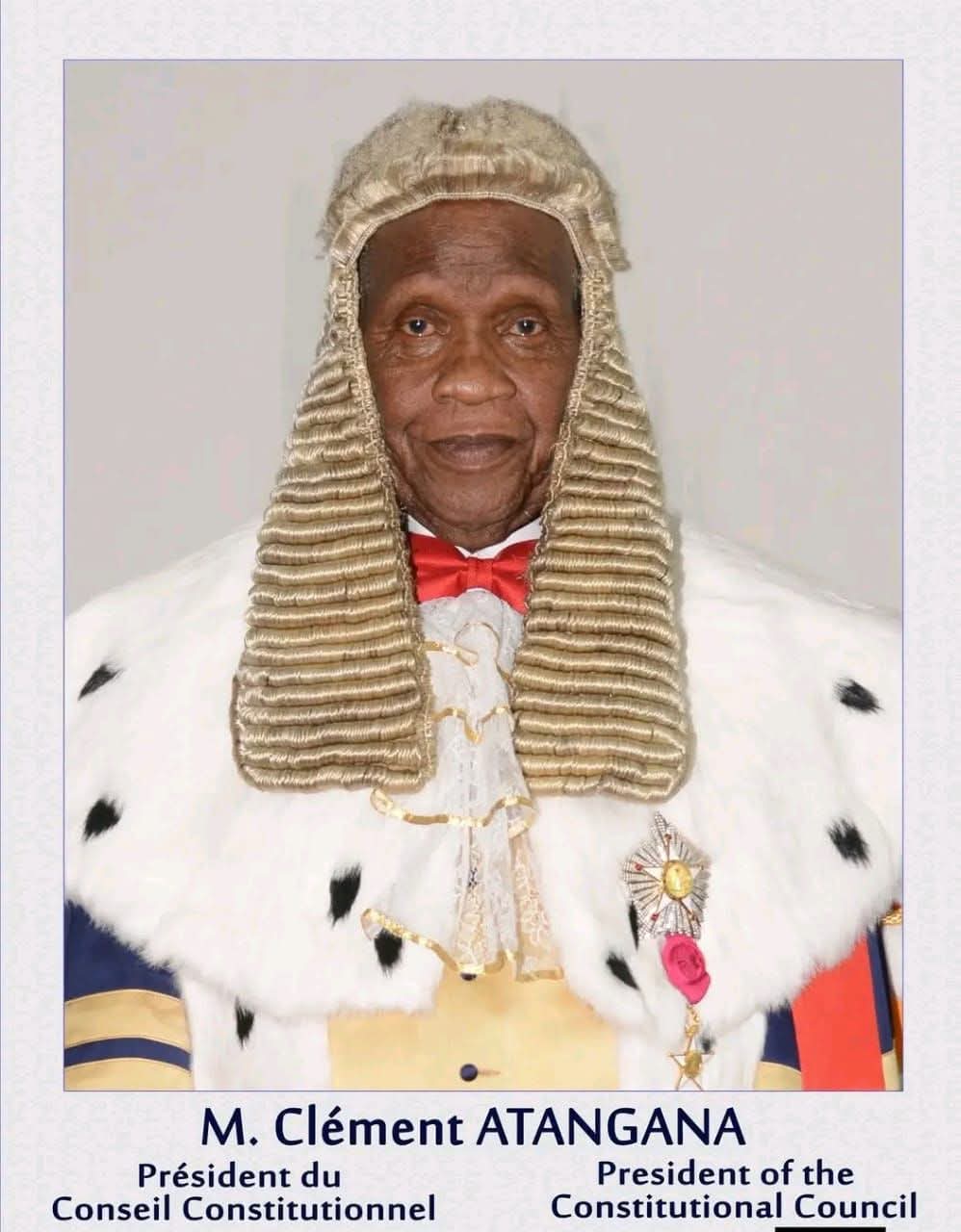
The passing of Clément Atangana in Paris has sent shockwaves through Cameroon’s political landscape, exposing deeper systemic issues within the nation’s electoral oversight body. The 85-year-old president of the Constitutional Council, who had been evacuated to France for medical treatment, leaves behind a legacy of controversy that has left the institution’s credibility in tatters.
The man behind the ‘irrecevable’ era
Born in Ngomedzap, Nyong-et-So’o region, Clément Atangana rose through the judicial ranks to become Cameroon’s top constitutional authority. His tenure, however, became synonymous with the controversial term irrecevable (unacceptable), a label he earned after the 2018 presidential election. During his watch, the Constitutional Council systematically dismissed all electoral appeals, reinforcing perceptions of institutional bias toward the ruling party.
Atangana’s reputation for partiality was cemented by a widely circulated video showing him celebrating Paul Biya’s re-election victory with his family, referring to the incumbent as your candidate. This public display of partisanship, combined with his participation in a 2025 political rally endorsing Biya’s candidacy, further eroded public trust in the judiciary’s neutrality.
Behind the scenes: institutional fragility exposed
The circumstances surrounding Atangana’s death have only amplified concerns about the Constitutional Council’s structural vulnerabilities. His evacuation to Paris for medical care underscored the institution’s lack of robust internal healthcare protocols, raising questions about its operational resilience. With Atangana’s departure, the Council now faces an unprecedented leadership vacuum at a time when Cameroon’s electoral integrity is under intense scrutiny.
The timing of his death—amid preparations for upcoming legislative and municipal elections—has intensified debates about the Council’s capacity to oversee a transparent electoral process. Critics argue that the institution’s perceived subservience to the ruling party has already compromised its legitimacy, and Atangana’s absence may accelerate its decline into irrelevance.
A legacy of contested rulings
- 2018 presidential election: The Council rejected all opposition appeals under Atangana’s leadership, reinforcing accusations of a predetermined outcome.
- 2025 political rally: Atangana’s participation in a pro-Biya event, despite his claims of attending an apolitical gathering, fueled perceptions of institutional capture.
- Healthcare crisis: His medical evacuation to Paris highlighted the Council’s lack of preparedness for leadership contingencies.
What lies ahead for Cameroon’s constitutional watchdog?
The death of Clément Atangana marks a critical inflection point for Cameroon’s electoral oversight mechanisms. With no clear successor in place, the Constitutional Council risks further fragmentation, potentially emboldening opposition groups to challenge future election results. The institution’s future now hinges on whether the government can appoint a leader capable of restoring public confidence—or whether the Council’s reputation as an arm of the ruling party will become irreversible.
As Cameroon prepares for another electoral cycle, the shadow of Atangana’s controversial tenure looms large. His passing is not merely the loss of an individual but the unraveling of an institution that has long been criticized for its lack of independence. The question now is whether Cameroon’s constitutional framework can survive the collapse of its most visible guardian.