
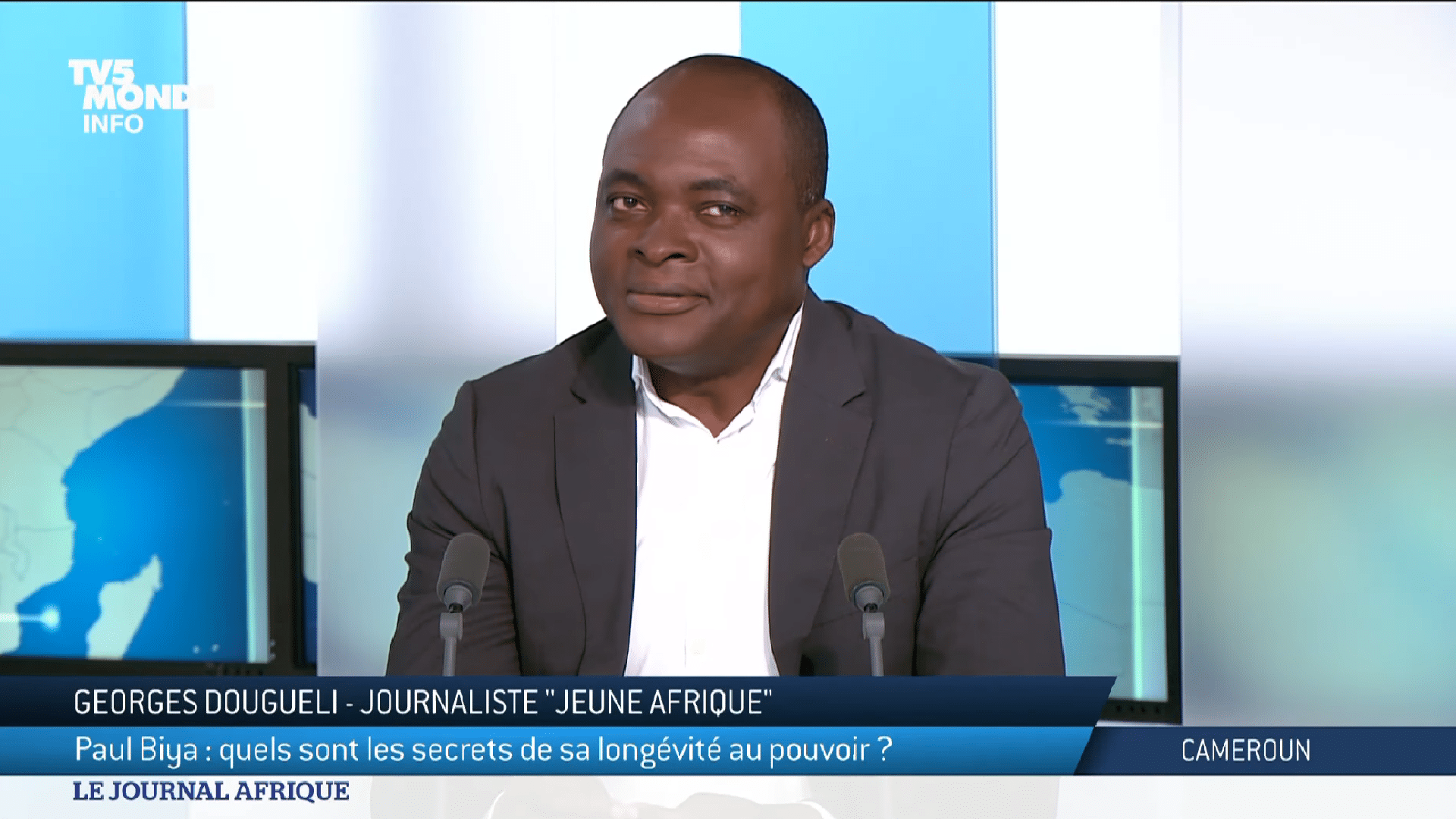
The dialogue between the media and the academic world in Cameroon has taken a sharp turn. In a recently released statement, a seasoned journalist has addressed the criticisms leveled by the Vice-rector of the University of Yaoundé II, asserting that the scrutiny of political leaders is a cornerstone of the profession.
The legitimacy of media speculation
The accusation that Georges Dougueli is speculating on the death of President Paul Biya has sparked a significant debate. Responding to the comments made by Owona Nguini during a television broadcast on June 26, the journalist argued that examining the health and longevity of a Head of State is not only valid but necessary. For those dedicated to the craft of reporting, no figure is beyond investigation, and the preparation of obituaries for living leaders is a standard, if somber, practice in newsrooms worldwide.
The journalist pointed out that political figures must expect this level of scrutiny. It is impossible to analyze the state of a nation without questioning the physical well-being of those who hold power. The critique suggests that the diatribe against him might be aimed at a specific audience, leading to a deeper sociological analysis of the professor’s public rhetoric.
Confronting ethnic supremacism
One of the primary concerns raised is the use of the Ekang concept, which has been popularized by Owona Nguini. Drawing from the work of Laburthe Tolra, the professor has been accused of manipulating mythology to support a supremacist narrative. This ideology suggests that certain groups have a natural vocation to rule territories across Central Africa, including Gabon, Guinée équatoriale, and Congo.
The dangers of such rhetoric are evident in the political history of neighboring Gabon, where similar sentiments led to the “Anything But Fangs” (TSF) movement during the 2009 elections. By identifying “enemies” within the population—whether they be political opposition groups or religious communities—this brand of intellectual agitation risks creating profound social instability. The journalist warns that this approach lacks the necessary finesse for delicate political landscapes.
Social division and the Fecafoot controversy
The conflict also touches on the management of the Fecafoot and the figure of Samuel Eto’o. The journalist argues that the attacks against the football legend are part of a broader effort to mobilize an elite clique against the common people. By labeling supporters of Samuel Eto’o as “uneducated” or “fanatics,” the academic discourse attempts to frame the struggle as “brains” against “muscles.”
This strategy seeks to isolate Samuel Eto’o and portray him as a detrimental force, potentially to distract from issues of corruption, poor governance, and political scandals within the ruling class. The journalist concludes by calling for a more rigorous analysis of these social dynamics by experts in law, politics, and psychology, as the current rhetoric threatens to undermine popular sovereignty in favor of high-level directives.