
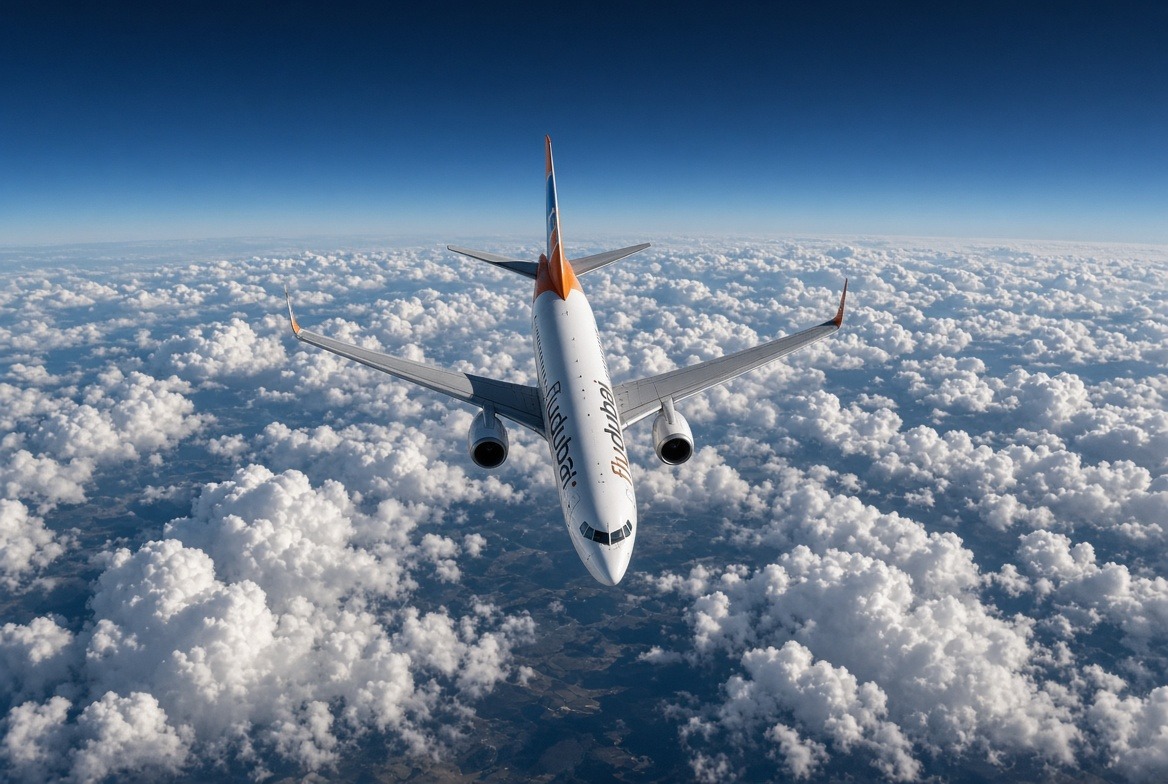
What began as a routine flight from Dubai to Tel Aviv became a defining moment in aviation security when a violent cockpit incident sent a Boeing 737 MAX 8 plunging thousands of feet, triggered hijacking alert codes, and forced an emergency landing in Saudi Arabia. In a matter of minutes, Flydubai flight FZ1073 shifted from an ordinary journey to the center of an international crisis — a turning point that has reshaped how authorities view cockpit safety.
The moment everything changed
On that Wednesday, the Flydubai Boeing 737 MAX 8 had departed Dubai bound for Tel Aviv with more than 150 passengers on board. Mid-flight, the situation escalated without warning.
Available tracking data reveals an extremely rapid descent: several thousand meters lost in a very short time. The aircraft then transmitted code 7700, signaling a general emergency, before emitting code 7500 — the code used when a crew reports unlawful interference on board, including situations that could indicate a hijacking.
For authorities and passengers on the ground, uncertainty was at its peak.
Israel launched a military response, scrambling fighter jets as a precaution. On board, several passengers described hearing screams and seeing blood. According to multiple witness accounts, a violent confrontation reportedly broke out between the two pilots, with one of them injured by a bladed weapon. Passengers then allegedly intervened in the cockpit.
Both pilots were hospitalized after the landing in Tabuk, Saudi Arabia. All passengers were reported safe and sound. Flydubai limited itself to confirming that an “incident” had occurred during the flight, without publicly specifying its nature.
The detail that rewrites the narrative
This is where the real journalistic turning point lies.
In the first hours, several accounts circulated almost simultaneously: hijacking, suicide attempt, terrorist attack, struggle between pilots. Some Israeli media even raised the possibility that a pilot intended to crash the plane.
But these scenarios are not equivalent, and above all, they are not yet established.
Two Israeli officials described the event as a possible “terrorist attack,” while specifying that the investigation was ongoing. Contradictory versions also emerged regarding the circumstances and even the nationality of the pilots.
In other words: the established fact is that of an extremely violent incident that triggered an emergency. The motive remains a matter of investigation.
Why the 9/11 comparison is premature
The analogy with the September 11, 2001 attacks carries particularly heavy consequences.
9/11 was a coordinated terrorist operation involving multiple hijacked planes used as weapons. In the case of Flydubai flight FZ1073, nothing in the publicly available information at this hour establishes the existence of a comparable plan, organization, or demonstrated intent to use the aircraft as a weapon.
However, some witness accounts describe a situation that, from the cabin, could have felt like an imminent catastrophe. A passenger cited by i24NEWS said she heard screams, saw blood, and believed the plane was going to crash.
This distinction is essential: the fear experienced by passengers is a fact; the terrorist interpretation of that fear remains a hypothesis.
The cockpit: a new gray zone in the investigation
The most intriguing element of this case may ultimately not be the dramatic code 7500, but what happened in the seconds before it was activated.
Who was actually controlling the aircraft?
Why did the plane abruptly lose altitude?
Who triggered the various emergency codes?
When did passengers enter the cockpit?
And above all: was one of the pilots actually trying to seize control of the aircraft to hijack it or crash it, or was the situation the result of a confrontation whose consequences spiraled beyond the crew’s control?
Flight data may help reconstruct the chronology. The flight recorders and communications with air traffic control will likely be decisive in distinguishing between a deliberate action, a struggle, or a momentary loss of control.
A crisis that goes far beyond the aircraft
The case takes on a particular dimension because the aircraft was carrying Israeli passengers and heading to Tel Aviv.
The alert occurred in a region already under significant security tensions. The plane ultimately had to land in Tabuk, Saudi Arabia — a country with which Israel still does not maintain official diplomatic relations.
Thus, an incident at several thousand meters altitude quickly transformed into a diplomatic and military problem: fighter jet intervention, Israeli security consultations, handling of Israeli nationals on Saudi territory, and an investigation involving multiple authorities.
This may be the real lesson of the affair.
In modern aviation, a few seconds of uncertainty in a cockpit can trigger consequences that far exceed the aircraft itself.
What we know — and what we don’t yet know
At this stage, several elements are established: the aircraft suffered a serious incident, both pilots were injured, the plane experienced a brutal descent, emergency codes were emitted, and the aircraft ultimately landed in Tabuk with passengers safe.
However, the motive of the protagonist(s), the exact intention behind the confrontation, and the possible existence of a plan to turn the aircraft into a weapon are not publicly established.
It is precisely this zone of uncertainty that should be at the heart of the journalistic investigation.
For in such a sensitive case, the most important question may not be: “Was this a new 9/11?”
It is rather: “How could a commercial airliner find itself in a situation where, for a few minutes, no one outside the cockpit knew who was actually in control?”
The answer now lies in the hands of investigators, flight data, the aircraft’s recorders, and testimonies gathered from the crew and passengers.