
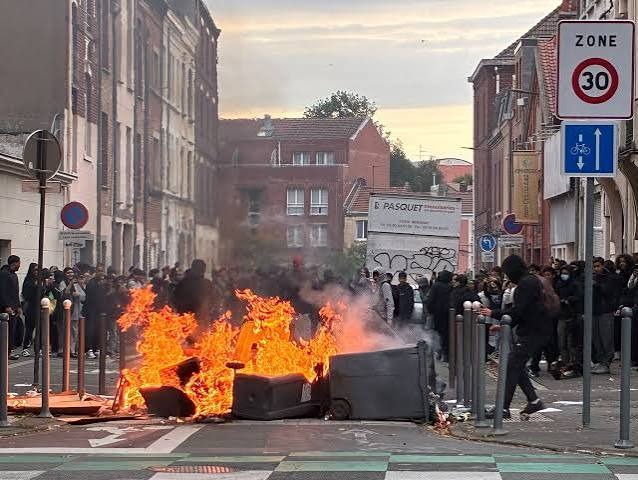
From peaceful dissent to urban upheaval: the day France’s youth movement turned violent
What began as a targeted wave of high school protests against education reforms escalated into an unprecedented afternoon of urban unrest across France. The shift wasn’t spontaneous—it was the result of deeper, unaddressed tensions converging in a single moment. By Thursday evening, schools stood vandalized, public transport crippled, and state authorities scrambling to regain control.
Why a protest spiralled out of control
The discontent had been brewing for weeks. Students from over 300 high schools initially organized peaceful blockades and marches to voice concerns over recent changes to the baccalaureate system and classroom conditions. But as the demonstrations spread through Paris, Lyon, Marseille, and other major cities, a third element infiltrated the movement: organized groups with no connection to education reform.
Unmarked individuals, some wearing black clothing and carrying projectiles, began exploiting the chaos. They turned school forecourts into battlegrounds, ignited barricades with trash bins, and hurled fireworks and stones at police lines. Social media accounts, many unverified, amplified calls for “disruptive action,” not dialogue.
From classrooms to barricades: the transformation of a movement
In Marseille, the peaceful sit-in at Lycée Saint-Charles dissolved within minutes when masked figures forced open gates and set fire to trash containers in the courtyard. Firefighters had to intervene under heavy projectile fire, using high-pressure water cannons to protect responders.
At Paris’s Lycée Voltaire, in the 11th arrondissement, students initially held signs reading “Youth Not for Sale.” By noon, the same courtyard was littered with broken glass, burnt furniture, and graffiti calling for “system collapse.” Over 40 schools in the Paris region alone reported serious damage to windows, doors, and educational materials by mid-afternoon.
The role of social media in fueling instability
Messages circulated on encrypted platforms promoted a coordinated “day of disruption,” urging participants to converge on transit hubs and school zones. While authorities monitored some accounts, many organizers operated on decentralized networks, making real-time interception difficult.
One viral video from Nantes showed a group of rioters loading supermarket trolleys with stones, then rolling them toward a police cordon. The clip, viewed over one million times by evening, became a rallying symbol for further unrest across France.
State response: emergency measures and political fallout
By 3 p.m., Prime Minister Sébastien Lecornu convened an extraordinary inter-ministerial crisis cell at the Ministry of the Interior. Joined by the ministers of National Education and Transport, the session had one goal: stabilize the situation before nightfall.
Public transit authorities in cities like Bordeaux, Toulouse, and Lille suspended service entirely across city centers. Commuter networks, already strained by engineering work, faced sudden paralysis—leaving thousands stranded and unable to reach work or home.
In a rare prime-time address from Matignon, Lecornu condemned the violence while acknowledging its deeper roots. “Protesting the system is legitimate. Destroying our schools is not. Tonight, France will deploy additional units to restore order and protect public institutions.”
Political reactions reveal a divided nation
Parliamentary leaders lined up to respond. Centre-right deputies demanded a blanket curfew near educational sites. Far-right speakers called for nationwide school closures. On the left, criticism centered on perceived government inaction—pointing to delayed responses and lack of youth consultation.
Union leaders, caught off guard, distanced themselves from the destruction. “Students are fighting for fair exams and better resources—not barricades,” said a spokesperson from the National Union of Secondary Students. “Yet tonight, our schools are burning—and no one is listening.”
What lies ahead: stability or more turbulence?
Security reinforcements are scheduled for deployment at first light across twenty high-risk districts. Patrols will increase around public transport nodes and school perimeters, backed by aerial surveillance drones.
But with forecasts predicting another wave of student mobilizations ahead of Friday’s planned rallies, the question remains: can the government regain control before the crisis spirals further?
The events of October 1st weren’t just a protest gone wrong. They exposed a fracture between generations, policies, and expectations. Restoring calm will require more than riot gear and water cannons. It demands addressing the very grievances that first brought students into the streets.