
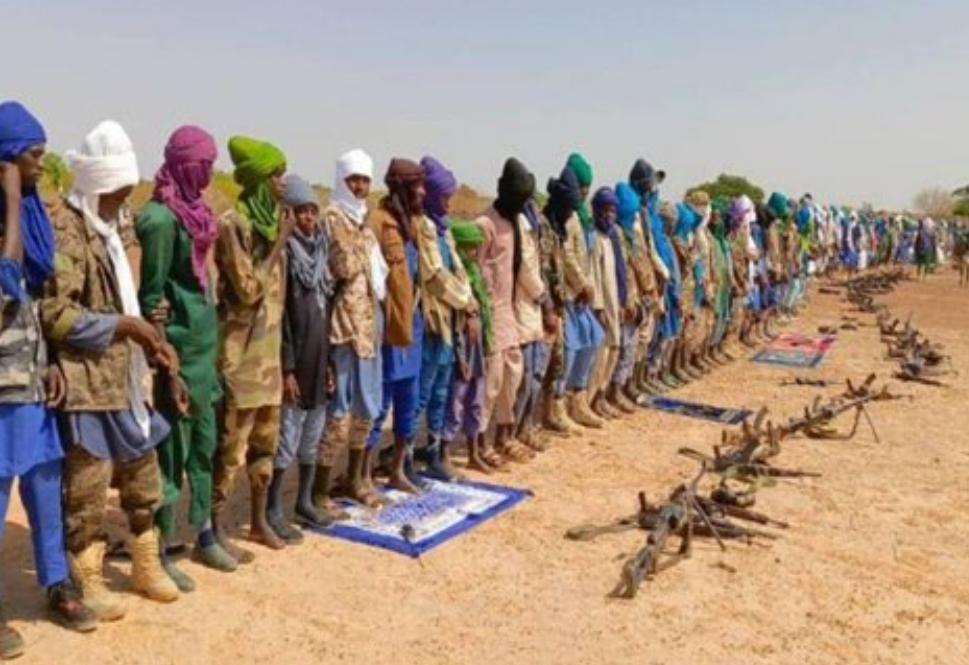
The region of Mopti in central Mali witnessed a fresh wave of coordinated assaults on Sunday, July 19, as the Group for the Support of Islam and Muslims (JNIM) launched four simultaneous strikes targeting Malian Armed Forces (FAMa), their Africa Corps allies, and local militias. The claim of responsibility underscores the group’s persistent operational freedom, five years after the coup that brought Colonel Assimi Goïta to power.
Coordinated assaults expose Mali’s deepening security crisis
The JNIM executed four distinct attacks across Mopti, demonstrating refined tactical execution and sustained pressure on state forces. In the Douentza area, the group detonated three improvised explosive devices (IEDs), striking a military convoy, a supply truck, and a motorcycle detachment carrying soldiers. These targets were deliberately chosen to disrupt the movement of both Malian troops and Russian mercenaries from Africa Corps—formerly associated with the Wagner Group. Farther east, near Kansila, the insurgents launched a direct assault on a local self-defense militia known as the Dozo hunters, frequently deployed by Bamako as auxiliary forces. According to their own accounts, the attack resulted in the deaths of three Dozo members.
Government’s security failures revealed in stark statistics
When the junta seized power, its central pledge was to reclaim full territorial control and restore peace, contrasting with the perceived shortcomings of previous democratic governments and Western partners such as Operation Barkhane. However, five years later, independent conflict data paints a bleak picture. Reports indicate a sharp rise in civilian and military casualties, with violent deaths doubling or even tripling in certain provinces compared to the pre-coup period. The conflict’s complexity has also escalated, as the emergence of Africa Corps and targeted attacks on specific communities have fueled ethnic tensions, inadvertently strengthening jihadist recruitment.
The frequency of ambushes and IED strikes has surged, transforming major roads into perilous zones. These tactics, including the July 19 assaults, have become near-daily occurrences, paralyzing critical supply routes and undermining public confidence in state security measures.
Loss of state control fuels worsening humanitarian crisis
Despite official claims of progress, the reality on the ground reveals a shrinking state presence. While the military has achieved symbolic victories—such as the recapture of Kidal in late 2023—it has struggled to maintain control over reclaimed territories. Large swathes of northern and central Mali now exist as ungoverned spaces, where public services have collapsed.
United Nations agencies report that over 400,000 people have been internally displaced, fleeing both militant violence and collateral damage from military operations. Blockades imposed by groups like the JNIM and the Islamic State in the Greater Sahara (EIGS) have plunged entire regions into severe food shortages. With roads insecure, humanitarian aid deliveries have ground to a halt, deepening the humanitarian emergency into a silent catastrophe.
Africa Corps: a costly partnership with little to show
In a strategic pivot away from the French army and the UN’s MINUSMA mission, Bamako turned to Moscow for support. Initially under the Wagner Group’s banner and now operating as Africa Corps—directly linked to Russia’s Defense Ministry—hundreds of Russian paramilitaries have been deployed. However, this partnership has yielded minimal military gains while exacerbating civilian suffering.
Human rights organizations have repeatedly documented abuses by Russian forces, including the Moura massacre, where civilians were allegedly targeted. Such violence drives local populations toward insurgent groups, who position themselves as protectors. Militarily, Africa Corps has failed to curb the jihadist threat, suffering consistent losses and lacking the personnel required for effective counterinsurgency across Mali’s vast terrain.
Air power’s limitations highlight military vulnerabilities
Facing a shortage of ground troops, the Goïta regime heavily invested in aerial assets, procuring drones and attack helicopters—primarily from Russia and Turkey (including Bayraktar TB2 drones and Mi-24 helicopters). While these acquisitions initially enabled large-scale airstrikes, the strategy now faces critical setbacks.
Technical failures and combat losses have grounded several aircraft, including L-39 Albatros jets and Mi-24 helicopters, due to crashes or rebel attacks. Maintenance has become a major challenge, hindered by costly Russian spare parts and logistical delays. Meanwhile, insurgents have adapted, dispersing into smaller units, hiding in vegetation, or blending with civilians—rendering airstrikes either ineffective or tragically indiscriminate.
A dead-end strategy rooted in militarization
The July 19 attacks in Mopti are not isolated incidents but symptoms of a systemic crisis. The government’s reliance on a military-first approach has reached its limits. By severing diplomatic channels, alienating regional allies, and aligning with Russian mercenaries seemingly more interested in resource extraction than stabilization, Bamako has cornered itself. Without a holistic strategy that prioritizes governance, public service restoration, and civilian protection, Mali risks further territorial fragmentation under the relentless pressure of a spreading Sahelian jihadism.