
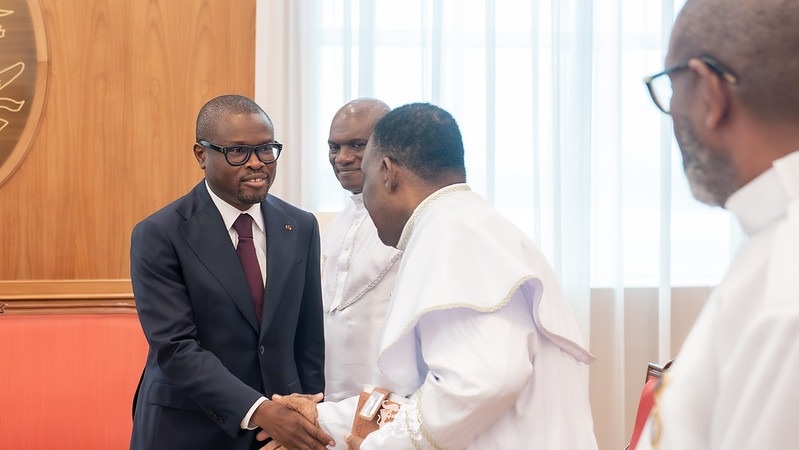
The meeting held on June 4, 2026, by President Romuald Wadagni with the delegation from the Celestial Church of Christ offers an unexpected political insight. It showcases an exemplary state transition where two leaders align their roles without friction, serving a peace process that extends far beyond the borders of Bénin.
Certain dossiers, by their very nature, reveal the true quality of governance. The reunification process of the Celestial Church of Christ is one such case. While it may not appear spectacular—unfolding in meeting rooms and through theological consultations—it demands unwavering continuity from political authorities. Any break in the state’s commitment would signal to the various church factions that the process is fragile and subject to the whims of the electoral calendar. This risk appears to have been perfectly managed.
A dual-presidency approach to a sensitive issue
To understand the uniqueness of this moment, one must look back at the ceremony where the High Council of Work (CST) presented its findings. On that day, Patrice Talon and Romuald Wadagni stood side by side. The former was still the sitting president, while the latter was the president-elect, yet to be sworn in. This joint presence was not merely protocol; it was deeply political. it indicated that this specific file had undergone an explicit transfer, reflecting a silent agreement between the two men on the necessity of ensuring its progress.
The events of June 4, 2026, provided a second demonstration of this well-oiled machinery. In the morning, Patrice Talon officially installed the High Council responsible for implementing the CST’s recommendations. By evening, Romuald Wadagni was receiving the delegation from that same Council. The sequence was almost choreographed in its timing: one establishes the framework, the other welcomes the participants; one legitimizes the structure, the other brings it to life.
Defining roles: a deliberate political architecture
This sequence highlights a carefully planned governance architecture. Patrice Talon has taken on the role of facilitator—a term in mediation describing one who creates the conditions for dialogue without acting as the final judge. His legitimacy in this matter is rooted in history, as the process was launched and structured under his mandate. For the ecclesiastical actors, he remains the guarantor of the methodology.
Meanwhile, Romuald Wadagni embodies active republican continuity. By reaffirming his support and offering encouragement to the delegation, he signals that the state is not just passing a folder along, but actively taking charge of it. This distinction is vital. While a simple handover would have sufficed to ensure a transition, Wadagni has gone further, showing personal interest and providing reassurance to the stakeholders.
A real-world test of leadership cohesion
Beyond the internal affairs of the Celestial Church of Christ, this dossier serves as a litmus test for the relationship between the two presidents. In many African transitions, projects left behind by an outgoing leader often fall into an institutional purgatory—neither officially abandoned nor fully embraced by the new administration. The temptation to start from scratch or let previous dynamics fade away is often strong.
In Bénin, the signal is the exact opposite. By involving himself actively in the early weeks of his mandate on a project initiated by his predecessor, Wadagni is establishing a core principle: the continuity of the state takes precedence over a change in agenda. If this trend continues across other sectors, it could become a defining characteristic of this new administration.
An issue with global implications
It would be a mistake to view this matter solely through a local lens. The Celestial Church of Christ is a global organization with followers across all continents. If its reunification succeeds, it will be an international event, with Bénin—the founding country—at its heart.
The commitment of both leaders to this file carries a diplomatic and symbolic weight that reaches far beyond Cotonou. It positions Bénin as a space for resolving global religious fractures and its leaders as responsible actors in a peace process affecting millions of believers. This represents a form of soft power—the ability to exert positive influence through mediation rather than force. The audience on June 4 was not merely a religious event; it was an act of foreign policy and national unity, proving that the power transfer between Patrice Talon and Romuald Wadagni was thorough and substantial.