
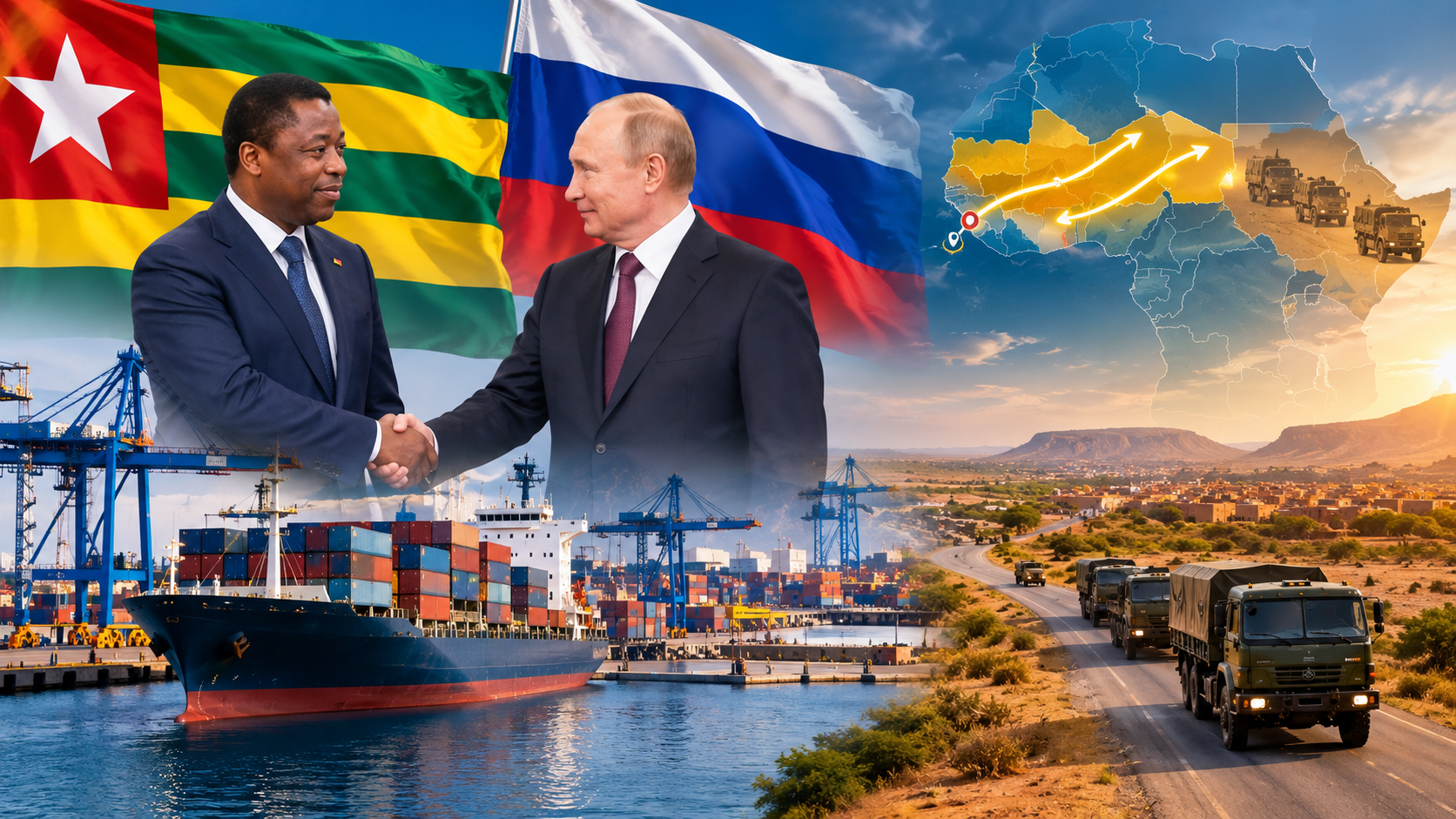
The strategic pivot: how Lomé became Russia’s backdoor to the Sahel
What initially appeared as a routine commercial agreement between Togo and Russia now reveals a deeper, unfolding strategy to reshape trade and logistics across West Africa and the Sahel. At the center of this realignment is Togo’s capital, Lomé, whose port and expanding infrastructure are quietly emerging as a critical node in Moscow’s African ambitions.
The initiative, formally presented during the first session of the Russian-Togolese intergovernmental commission in Lomé from late September to early October 2026, involves a proposed transport corridor designed to streamline the movement of Russian goods into Togo and key Sahelian markets. A Russian delegation of 29 officials engaged with Togolese counterparts, focusing on costs, timelines, infrastructure, and the potential for deeper trade integration. Key sites inspected included the Lomé Autonomous Port, Gnassingbé Eyadéma International Airport, and the industrial hub at Adétikopé.
On the surface, this is a logistics and commerce project. But the timing, geopolitical context, and shadow logistics already in motion suggest a far broader agenda one that blurs the line between trade and strategic influence.
The Mikhail Britnev precedent: logistics with a military shadow
The most concrete evidence of this emerging network came in July 2026, when the Russian cargo ship Mikhail Britnev, previously sanctioned by the United States, docked at Lomé. Satellite tracking and shipping data confirm the arrival, followed shortly after by a military convoy detected in Bamako, Mali. Analytical reports, including those from maritime intelligence specialists, indicate that the vessel transported armored personnel carriers and troop transport trucks—vehicles later documented as part of the Africa Corps’ fleet in Mali. Approximately 50 military vehicles were reportedly offloaded, channeled through Togo and Burkina Faso en route to Mali.
This was not an isolated incident. It demonstrated that Lomé’s port could already serve as a maritime gateway to inland Sahel conflict zones, linking sea routes to overland supply networks.
From logistics to strategic corridor: the realignment of Sahelian trade flows
The new corridor initiative, while framed in economic terms, reflects a deliberate effort by Russia to secure dependable access to Sahel markets. The focus is no longer limited to commercial trade; it extends to securing transport infrastructure, energy partnerships, and control over key trade arteries.
Lomé offers distinct advantages: a deep-water port with modern facilities, strong road links to neighboring countries, and the emerging industrial zone at Adétikopé, which includes storage, processing, and redistribution capabilities. This transforms the port from a mere transit point into a potential regional hub capable of receiving, storing, consolidating, and redistributing goods including sensitive shipments.
The industrial dimension: Adétikopé as a strategic asset
During their October visit, Russian officials toured the Plateforme Industrielle d’Adétikopé (PIA), a 400-hectare complex with warehousing, light manufacturing, and logistics parks. While framed as a commercial opportunity, such infrastructure could facilitate the blending of civilian and military logistics making Togo not just a port of call, but a processing and staging ground for Russian operations in West Africa.
Regional fragmentation and the rise of Lomé
The closure of the Benin-Niger border and shifting alliances across the Sahel are reconfiguring trade routes. With traditional partners like France and the EU diminishing their presence in parts of the Sahel, regional actors are seeking new partners and new corridors.
Lomé sits at the crossroads of these changes. Its port remains operational, its politics stable, and its geography favorable. It is no longer just a secondary option it is becoming a gateway. The question is whether Togo will leverage this position purely for economic gain or allow it to evolve into a geopolitical asset for Moscow.
The Togolese factor: government ambitions and red flags
Togolese President Faure Gnassingbé has long cultivated ties with Russia, culminating in a high-profile meeting with Vladimir Putin in November 2025. The agreements signed then focused on energy, security, and logistics, with Moscow reportedly gaining greater access to Togolese territory, including the presence of Russian security personnel.
This has fueled speculation about Togolese intentions. Is Lomé being positioned as a neutral commercial hub, or is it gradually integrating into a Russian-led logistics and security network? The answer may lie in how far Togo is willing to lean into this partnership and whether the benefits outweigh the risks of becoming entangled in external security dynamics.
What comes next: between commerce and geopolitical leverage
The new transport corridor is still on the drawing board. No fixed timeline has been announced. But the groundwork is already laid.
Russia is not merely seeking new markets. It is building infrastructure ports, roads, warehouses, and industrial zones that can serve multiple purposes: trade, energy, and, when necessary, military logistics. Lomé’s emergence as a potential hub reflects this broader ambition.
The real test will come when the first major consignments under the new corridor begin to flow. Will they be industrial equipment and consumer goods or something with a far heavier strategic footprint?
One thing is certain: in a Sahel where alliances are rapidly mutating, where borders are contested, and where traditional trade routes are breaking down, the port of Lomé is quietly stepping into a role it never anticipated not just as a transit point, but as a linchpin.
By Yvette Tchuente — Journalist